June 5, 2011
Another school year is coming to a close! This will be the last post of the school year. It's hard to believe that the year is actually ending. I've had a really enjoyable experience with this group of students, so it will be hard to say goodbye to them.
Events of the Past Week
Monday - No School. Thank you to all those who have served our country and paid the ultimate sacrifice.
Tuesday - We first learned a little bit about a topic called succession. There are two types of succession, both primary and secondary, which the students learned about through a PowerPoint presentation. Afterwards, they worked on a packet that had them try to relate some vocabulary words we learned during the course of the unit. There were also some questions related to succession in that packet. Homework was to finish the packet.
Wednesday - We first did a worksheet that taught students about the concept of population density, and had them calculate population density in two ways. The first was the counting method, where every individual in a given area is counted. The second was the census method, in which a few small areas within an entire habitat are chosen to be counted, and the population density is calculated from the sample taken.
Afterwards, the students were introduced to age structure graphs. They were given population data for Germany, Haiti, and the United States. The population data was divided by age groups (0-4, 5-9, 10-14, etc. all the way to 100+). It was also divided by gender within each age group. The students created a bar graph using this data, then answered questions about the graphs they created. One of their tasks was to identify which country went with which graph (they were not given that information at the start).
Homework was to finish the age structure graphs by Friday.
Thursday - The students took the district assessment test, which was a pilot test this year. Not surprisingly, the topics on which the students did the worst were first semester topics like biochemistry. There will be a small point value assigned to this test. Homework was to complete the age structure graphs if they were not done with them yet.
Friday - I collected the age structure graphs from the students and talked to them about the results of the district assessment test. Following that, we went over the population density assignment together. Then we learned about our last two ecology concepts: the niche, and survivorship curves. Neither concept is extremely complex, and everyone seemed to have a good handle on the concepts when we were done. Finally, we watched the YouTube video "Battle at Kruger," which showed the interactions between predators and their prey in a very real, very interesting way!
Upcoming Events
Monday - We will review for finals. The students will be able to ask me any questions they have about any second semester topics. Afterwards, they will be given time to study on their own or with a partner, whichever they choose.
Tuesday - The plan is the same as Monday.
Wednesday - Final Exams for my second and third hour accelerated biology classes. The final exam for all of my classes is 165 multiple choice questions covering the following topics: Meiosis, Mendelian Genetics, Evolution, Taxonomy, Anatomy and Physiology, and Ecology.
Thursday - Final Exam for my fourth hour accelerated biology class.
Friday - Final Exam for my eighth hour accelerated biology class.
Graba Geek of the Week
This week, my geek of the week goes to all of my students who managed to make it through a whole year of accelerated freshman biology! It was not an easy road to make it to the end, and I know it. I think, however, that most of my students would tell you that they have learned a lot about biology, about being successful in school, and about how much they are capable of accomplishing when they are pushed. Have a good summer, everyone!
June 5, 2011


May 29, 2011
May 29, 2011
Happy Memorial Day! I hope everyone enjoys a good hot dog or hamburger and the great outdoors this weekend.
Events of the Past Week
Monday - The students turned in their "Introduction to Ecology" packets to me.
Aftwerwards, we went over the Anatomy and Physiology test from the previous week. The results on the multiple choice portion of the test were outstanding! The lab practical proved to be a little bit more difficult; however, many students did very well on that part of the test. In comparison to previous years, the kids did very well.
Finally, we began our ecology unit in earnest by reading aloud an article called "A View From the Top of the Food Pyramid." After that, we did an activity that had the students look at how energy moves through an ecosystem, which they had to finish for homework.
Tuesday - I collected from the students their homework on energy flow in ecosystems. Then we worked on a case study to introduce the concepts of bioaccumulation and biomagnification. It was called "Tuna for Lunch," and had the students examine what happens to toxins such as mercury as they pass from one level of a food chain to the next. Your kids should be able to tell you the distinction between bioaccumulation and biomagnification after doing this activity. One neat memory trick that a student came up with was a rhyme that went something like, "Bioaccumulation occurs when an organism is single, biomagnification occurs when organisms mingle." That will make more sense to you after you ask your kids to explain the distinction if you don't already know what those two terms mean!
Wednesday - We learned about how three nutrients (carbon, nitrogen, and water) cycle through ecosystems. The activity took less time than anticipated, so we were able to move on to learn about the natural cycle between predators and their prey that occurs in nature.
We took a look at data from two real life examples (the deer of the Kaibab plateau in Arizona and the Moose of Isle Royale in Michigan) to begin our study of these cycles. Homework was to finish the analysis of the data they were presented with in the activity.
Thursday - We modeled predator/prey population cycles by doing a lab simulating populations of mice and weasels in a forest. Most groups generally got good data that showed that the population of prey always increases before the predator population, then decreases before the predator population. Homework was to finish graphing the data that was collected during the lab and to answer four questions related to the simulation. I also collected the homework from the night before.
Friday - We began class by taking a look at our data from the previous day's activity and making sure everyone was comfortable with the concept that was intended to be learned from that activity.
We then moved on to learn about symbiotic relationships such as mutualism, commensalism, parasitism, predation, and competition. Students were given descriptions of several different real life examples of these types of relationships, and then asked to identify the type of relationship described. When everyone was finished (this activity took about 15 minutes), the students checked their answers against my key.
Finally, we watched a movie that is a cautionary tale about the impact of humans on the environment, "The Lorax"! The kids loved it, and also had some pretty thought provoking questions to answer as they watched the movie.
For homework, I passed out a reading called "Lessons from the Wolf." This article was taken from a 2004 edition of Scientific American. There are several questions that go along with the reading that the students are to type their answers to using complete sentences.
Upcoming Events
Monday - NO SCHOOL! Thank you to those who have served our country, especially to those who paid the ultimate sacrifice for us.
Tuesday - I will collect the answers the students typed to the questions that went with their weekend reading.
Afterwards, we will learn about succession in an ecosystem (where either a new ecosystem develops where one had never been there before, such as on a new island formed from a volcanic eruption; or one develops to replace an older ecosystem that had been destroyed, such as in Yosemite after a massive forest fire).
We will then take a look at gross and net primary productivity in an ecosystem.
Wednesday - We will begin class by learning about population density, including how it is calculated and what factors affect it. We will be then learning about how to interpret age structure graphs. After that, we will take a look at survivorships curves.
Thursday - The students will take the 55 question district assessment test. This test was designed with regular level biology students in mind, so it should be relatively easy for most students in accelerated biology. It will be worth a small number of point (no more than 20-25). The topics covered are the scientific method, biochemistry, cells, molecular genetics, evolution, and Mendelian genetics.
Friday - We will only have 28 minutes in class, so we will spend a little bit of time going over the district assessment test. Then I'll pass out the final exam review sheet to the students and look it over with them, answering any questions they might have about the final exam or any of the topics on the review sheet.
Graba Geek of the Week
This week's geek of the week is Helen Chvoy. Helen is incredibly helpful to anyone who asks for her help in class. She also does a great job with her homework, labs, quizzes, and tests. Helen is one of the first people to volunteer to answer a question, especially when nobody else is willing to take a shot at it. It has been fantastic to have her as a student this year!

Other tidbits
There was a recent article in The Economist about a teacher who used a "flipped classroom" for his college class. It involved students watching video of his lectures at home that he recorded for them. Class time was then spent reinforcing those ideas and asking the students to think critically about them. The results were astounding at the university level, and many teachers on the AP Biology listserv I'm a part of are thinking about doing it in their classrooms. My only concern is that it would really add to the students' homework load, which is already very high. I'm also not sure it would be an appropriate approach for a high school freshman level course. I would be interested to hear your thoughts on the concept. The article is available here: http://www.economist.com/node/18678925
I also received an e-mail from the United States Achievement Academy regarding potential scholarship grants for students in grades 6-12. Here is a section from the e-mail I received:
Events of the Past Week
Monday - The students turned in their "Introduction to Ecology" packets to me.
Aftwerwards, we went over the Anatomy and Physiology test from the previous week. The results on the multiple choice portion of the test were outstanding! The lab practical proved to be a little bit more difficult; however, many students did very well on that part of the test. In comparison to previous years, the kids did very well.
Finally, we began our ecology unit in earnest by reading aloud an article called "A View From the Top of the Food Pyramid." After that, we did an activity that had the students look at how energy moves through an ecosystem, which they had to finish for homework.
Tuesday - I collected from the students their homework on energy flow in ecosystems. Then we worked on a case study to introduce the concepts of bioaccumulation and biomagnification. It was called "Tuna for Lunch," and had the students examine what happens to toxins such as mercury as they pass from one level of a food chain to the next. Your kids should be able to tell you the distinction between bioaccumulation and biomagnification after doing this activity. One neat memory trick that a student came up with was a rhyme that went something like, "Bioaccumulation occurs when an organism is single, biomagnification occurs when organisms mingle." That will make more sense to you after you ask your kids to explain the distinction if you don't already know what those two terms mean!
Wednesday - We learned about how three nutrients (carbon, nitrogen, and water) cycle through ecosystems. The activity took less time than anticipated, so we were able to move on to learn about the natural cycle between predators and their prey that occurs in nature.
We took a look at data from two real life examples (the deer of the Kaibab plateau in Arizona and the Moose of Isle Royale in Michigan) to begin our study of these cycles. Homework was to finish the analysis of the data they were presented with in the activity.
Thursday - We modeled predator/prey population cycles by doing a lab simulating populations of mice and weasels in a forest. Most groups generally got good data that showed that the population of prey always increases before the predator population, then decreases before the predator population. Homework was to finish graphing the data that was collected during the lab and to answer four questions related to the simulation. I also collected the homework from the night before.
Friday - We began class by taking a look at our data from the previous day's activity and making sure everyone was comfortable with the concept that was intended to be learned from that activity.
We then moved on to learn about symbiotic relationships such as mutualism, commensalism, parasitism, predation, and competition. Students were given descriptions of several different real life examples of these types of relationships, and then asked to identify the type of relationship described. When everyone was finished (this activity took about 15 minutes), the students checked their answers against my key.
Finally, we watched a movie that is a cautionary tale about the impact of humans on the environment, "The Lorax"! The kids loved it, and also had some pretty thought provoking questions to answer as they watched the movie.
For homework, I passed out a reading called "Lessons from the Wolf." This article was taken from a 2004 edition of Scientific American. There are several questions that go along with the reading that the students are to type their answers to using complete sentences.
Upcoming Events
Monday - NO SCHOOL! Thank you to those who have served our country, especially to those who paid the ultimate sacrifice for us.
Tuesday - I will collect the answers the students typed to the questions that went with their weekend reading.
Afterwards, we will learn about succession in an ecosystem (where either a new ecosystem develops where one had never been there before, such as on a new island formed from a volcanic eruption; or one develops to replace an older ecosystem that had been destroyed, such as in Yosemite after a massive forest fire).
We will then take a look at gross and net primary productivity in an ecosystem.
Wednesday - We will begin class by learning about population density, including how it is calculated and what factors affect it. We will be then learning about how to interpret age structure graphs. After that, we will take a look at survivorships curves.
Thursday - The students will take the 55 question district assessment test. This test was designed with regular level biology students in mind, so it should be relatively easy for most students in accelerated biology. It will be worth a small number of point (no more than 20-25). The topics covered are the scientific method, biochemistry, cells, molecular genetics, evolution, and Mendelian genetics.
Friday - We will only have 28 minutes in class, so we will spend a little bit of time going over the district assessment test. Then I'll pass out the final exam review sheet to the students and look it over with them, answering any questions they might have about the final exam or any of the topics on the review sheet.
Graba Geek of the Week
This week's geek of the week is Helen Chvoy. Helen is incredibly helpful to anyone who asks for her help in class. She also does a great job with her homework, labs, quizzes, and tests. Helen is one of the first people to volunteer to answer a question, especially when nobody else is willing to take a shot at it. It has been fantastic to have her as a student this year!

There was a recent article in The Economist about a teacher who used a "flipped classroom" for his college class. It involved students watching video of his lectures at home that he recorded for them. Class time was then spent reinforcing those ideas and asking the students to think critically about them. The results were astounding at the university level, and many teachers on the AP Biology listserv I'm a part of are thinking about doing it in their classrooms. My only concern is that it would really add to the students' homework load, which is already very high. I'm also not sure it would be an appropriate approach for a high school freshman level course. I would be interested to hear your thoughts on the concept. The article is available here: http://www.economist.com/node/18678925
I also received an e-mail from the United States Achievement Academy regarding potential scholarship grants for students in grades 6-12. Here is a section from the e-mail I received:
"For more than 30 years, the USAA Scholarship Foundation has recognized outstanding students because of dedicated teachers like you. The Foundation is happy to provide the students you recognized the opportunity to apply for cash grants.
It is the sole purpose of the USAA Scholarship Foundations to help students in grades 6-12 by awarding cash grants to use now or later for any educational expense.
* $40,000 in scholarship cash grants reserved for middle school students
* $40,000 in scholarship cash grants reserved for high school students
* One $10,000 Dr. George A. Stevens, Founder's Award
Choose your students based on any two of the following Standards for Selection: 3.0 minimum in your subject, motivation to learn and improve, attitude, dependability, responsibility, and leadership qualities."
There is a link provided for parents to begin the application process as well. This will allow you to apply without necessarily requiring a recommendation from me. Here is the website to apply for the scholarships: http://fs22.formsite.com/USAA/form23/index.html
May 22, 2011
May 22, 2011
I hope everyone enjoyed the great weather we had over this last weekend! Our family played a lot of baseball together and enjoyed being outside.
Events of the Past Week
Monday - We watched a video in class because I was not there. The video was about reptiles and many of their adaptations, including adaptations for breathing which tied into learning about the respiratory system.
Tuesday - We reviewed the functions of the parts of the respiratory system and learned about the urinary system via a lecture about the parts of the system and what they do.
Wednesday - The students reviewed for their test on anatomy and physiology by looking at the quizzes they had taken during this unit as well as by looking at labs and homework assignments they had completed. They were able to ask me any questions that they had on anything related to those quizzes and assignments as well as about the test itself.
Thursday - The students took the 75 question multiple choice test on anatomy and physiology and did very well, for the most part. I was very impressed with their effort!
Friday - We took the lab practical portion of the test. There were 7 pigs and one calf heart set up around the room with pins in them. At each station the students had 1 minute to answer three questions about the organs the pins were placed into. While they waited for their turn or after they finished, the students were working on a packet that introduced them to some important terms and concepts related to ecology, which is our next unit. Anything in that packet that was not finished needs to be completed for homework.
Upcoming Events
Monday - I will be collecting the "Introduction to Ecology" packet from the students. After that we are going to take a look at both parts of our test on anatomy and physiology.
We will then be spending our class time working on learning about food chains and energy transfer in an ecosystem. There is an activity the students will be doing in pairs to help them learn about this topic. Our focus will be more about what happens to the energy in a food chain than on what organisms eat what other organisms. I assume that most of the students know that some kind of herbivore will eat plants, and some kind of carnivore will eat the herbivores, so I don't want to bore them. By focusing on the flow of energy through an ecosystem the students will be asked to think at a higher level than if they were just asked to identify which organism eats which other organism. A food chain and food web packet will be assigned for homework, as well.
Tuesday - The assignment that we worked on in class will be collected, while the homework will be gone over in class. Anyone who does not have the homework assignment completed, however, will be asked to step into the hallway to complete it while the rest of us go over it together.
After we have gone over the homework, the students will be doing a case study called "Tuna for Lunch?" They will be working in pairs on this assignment. The purpose of the assignment is to investigate the way in which toxins such as mercury accumulate and undergo what is called "biomagnification" as they pass up the food chain. Hopefully your children will be able to tell you what biomagnification is after having completed this assignment.
Wednesday - We will begin looking at how nutrients are cycled through an ecosystem with a jigsaw assignment. The students will be in groups of 3. One person will become an expert on the carbon cycle, one on the nitrogen cycle, and one on the water cycle. After each person has become an expert, they will teach the other members of the group about their topic. Then the students will have some questions to answer about each cycle. For homework, the students will be doing an assignment called "Ecology Cycles" to look at how other factors may cycle in an ecosystem.
Thursday - On Thursday, we will be doing a lab to look at how predator and prey populations affect one another and have a definite cycle in nature. For homework, the students will be completing an assignment called "Analyzing Ecological Relationships," where they will be asked to look at 3 different graphs and interpret the information they present.
Friday - I will collect the homework on Friday, and then we will look at a real life example of the effects of the removal of a predator (the wolf) on their prey (the deer) on the island of Kaibab.
Afterwards, the students will be introduced to symbiotic relationships. These are relationships in which two organisms live in close association with one another. The types of relationships can be mutualistic (where both organisms benefit), commensalistic (where one benefits while the other is neither hurt nor harmed), parasitic (where one organism benefits at the other's expense), competitive (where both organisms are trying to obtain the same resource), or predatory (where one organism preys on the other). After a brief introduction to these relationships, the students will be given a variety of different examples of symbiotic relationships to read about and identify.
For homework, the students will be given an article to read about the importance of the wolf to the ecosystem in Yellowstone. This article comes from the journal Scientific American. There will be several questions the students will be answering to go along with this reading. The article does an excellent job explaining how many of the organisms in Yellowstone are dependent on one another, as well as how disrupting even just one of those organisms dramatically impacts the rest.
Graba Geek of the Week
This week's Geek of the Week is Hannah Kuhl. Hannah has been one of the top-performing students in class all year long, and culminated her efforts with a perfect score on the 75 question multiple choice test we took on anatomy and physiology. In addition, she earned 24 out 25 possible points on the lab practical we took on Friday, earning her high score on that part of the test as well. Way to go, Hannah!

Events of the Past Week
Monday - We watched a video in class because I was not there. The video was about reptiles and many of their adaptations, including adaptations for breathing which tied into learning about the respiratory system.
Tuesday - We reviewed the functions of the parts of the respiratory system and learned about the urinary system via a lecture about the parts of the system and what they do.
Wednesday - The students reviewed for their test on anatomy and physiology by looking at the quizzes they had taken during this unit as well as by looking at labs and homework assignments they had completed. They were able to ask me any questions that they had on anything related to those quizzes and assignments as well as about the test itself.
Thursday - The students took the 75 question multiple choice test on anatomy and physiology and did very well, for the most part. I was very impressed with their effort!
Friday - We took the lab practical portion of the test. There were 7 pigs and one calf heart set up around the room with pins in them. At each station the students had 1 minute to answer three questions about the organs the pins were placed into. While they waited for their turn or after they finished, the students were working on a packet that introduced them to some important terms and concepts related to ecology, which is our next unit. Anything in that packet that was not finished needs to be completed for homework.
Upcoming Events
Monday - I will be collecting the "Introduction to Ecology" packet from the students. After that we are going to take a look at both parts of our test on anatomy and physiology.
We will then be spending our class time working on learning about food chains and energy transfer in an ecosystem. There is an activity the students will be doing in pairs to help them learn about this topic. Our focus will be more about what happens to the energy in a food chain than on what organisms eat what other organisms. I assume that most of the students know that some kind of herbivore will eat plants, and some kind of carnivore will eat the herbivores, so I don't want to bore them. By focusing on the flow of energy through an ecosystem the students will be asked to think at a higher level than if they were just asked to identify which organism eats which other organism. A food chain and food web packet will be assigned for homework, as well.
Tuesday - The assignment that we worked on in class will be collected, while the homework will be gone over in class. Anyone who does not have the homework assignment completed, however, will be asked to step into the hallway to complete it while the rest of us go over it together.
After we have gone over the homework, the students will be doing a case study called "Tuna for Lunch?" They will be working in pairs on this assignment. The purpose of the assignment is to investigate the way in which toxins such as mercury accumulate and undergo what is called "biomagnification" as they pass up the food chain. Hopefully your children will be able to tell you what biomagnification is after having completed this assignment.
Wednesday - We will begin looking at how nutrients are cycled through an ecosystem with a jigsaw assignment. The students will be in groups of 3. One person will become an expert on the carbon cycle, one on the nitrogen cycle, and one on the water cycle. After each person has become an expert, they will teach the other members of the group about their topic. Then the students will have some questions to answer about each cycle. For homework, the students will be doing an assignment called "Ecology Cycles" to look at how other factors may cycle in an ecosystem.
Thursday - On Thursday, we will be doing a lab to look at how predator and prey populations affect one another and have a definite cycle in nature. For homework, the students will be completing an assignment called "Analyzing Ecological Relationships," where they will be asked to look at 3 different graphs and interpret the information they present.
Friday - I will collect the homework on Friday, and then we will look at a real life example of the effects of the removal of a predator (the wolf) on their prey (the deer) on the island of Kaibab.
Afterwards, the students will be introduced to symbiotic relationships. These are relationships in which two organisms live in close association with one another. The types of relationships can be mutualistic (where both organisms benefit), commensalistic (where one benefits while the other is neither hurt nor harmed), parasitic (where one organism benefits at the other's expense), competitive (where both organisms are trying to obtain the same resource), or predatory (where one organism preys on the other). After a brief introduction to these relationships, the students will be given a variety of different examples of symbiotic relationships to read about and identify.
For homework, the students will be given an article to read about the importance of the wolf to the ecosystem in Yellowstone. This article comes from the journal Scientific American. There will be several questions the students will be answering to go along with this reading. The article does an excellent job explaining how many of the organisms in Yellowstone are dependent on one another, as well as how disrupting even just one of those organisms dramatically impacts the rest.
Graba Geek of the Week
This week's Geek of the Week is Hannah Kuhl. Hannah has been one of the top-performing students in class all year long, and culminated her efforts with a perfect score on the 75 question multiple choice test we took on anatomy and physiology. In addition, she earned 24 out 25 possible points on the lab practical we took on Friday, earning her high score on that part of the test as well. Way to go, Hannah!

May 15, 2011
May 15, 2011
May 15, 2011
Events of the Past Week
Monday - The first thing we did in class was take 5 minutes with our lab partners to look over our heart anatomy labs that were due. Afterwards, I chose one student's lab from each group to collect and grade. We then looked at our digestive system quizzes so that the students could figure out what they did not know that they were asked about on the quiz. Finally, we watched the movie "Hemo the Magnificent," which does a nice job of giving an overview of the heart, blood circulation, and characteristics of arteries, veins, and capillaries.
Tuesday - I lectured to the students on the circulatory system. We covered the functions of the circulatory system, the parts of blood, the anatomy and physiology of the heart, and the anatomy of blood vessels.
Wednesday - All of the freshman biology teachers were given a time grant on Wednesday to work on developing our ecology unit. Ecology is a topic we usually do not spend much time on, but given the new push globally for going green and finding renewable resources, we thought that this ought to be a topic we spend more time on in class. While we were meeting, the students were working on interpreting a graph related to the circulatory system, labeling a diagram of the heart, completing a crossword puzzle of vocabulary from the circulatory system, and working on a study guide that corresponded with their textbook on the circulatory system. For homework the students completed the study guide.
Thursday - We took a quiz on the circulatory system. Afterwards, the students completed a diagram that had them label the parts of the respiratory system, which we then checked afterwards.
Friday - We completed our final dissection of our fetal pigs! This included the parts of the respiratory system both in the mouth and the thoracic (chest) cavity, as well as the parts of the urinary system. Your kids should be able to tell what the four parts of the urinary system are and what the general function of each part is. For homework they should be completing all of the questions in the lab handout from our dissection.
Upcoming Events
Monday - We will be using our textbooks in class to review some of the anatomy and physiology of the respiratory system. Please let your children know that they need to bring their textbooks to class, as I forgot to remind them on Friday. Thank you!
Tuesday - I'll be lecturing on the anatomy and physiology of the respiratory system, including the functions of each of the parts of the respiratory system as well as the mechanics and control of breathing rate.
Wednesday - We will review for our test on Thursday. We may use our CPS system (remote control quiz setup) to do this. The test is usually relatively difficult because there is a lot of material to remember, so make sure your children start studying before Wednesday night. They should study their class notes and their lab handouts.
Thursday - The test will include approximately 75 multiple choice questions and 25 lab practical questions. The lab practical will involve 8 stations with 7 pigs and my calf heart. At each station the students will have one minute to look at various parts of the pig or heart with pins in them. There will be about 3 questions per station that either ask the students to identify a body part or tell me something about what the body part does for the organism.
Friday - We will review our test results and begin our ecology unit with a handout called "Introduction to Ecology," which the students will be completing for homework.
Graba Geek of the Week
This week's geek of the week goes to Matt Faust, who works really hard at everything he does in biology. As a result, he is consistently at the top of the class on quizzes and tests. His homework and lab work are also very well done, which is probably one of the big reasons he does so well on quizzes and tests. Matt also asks very good questions in class and is not afraid to answer questions, either. Congratulations, Matt!

Events of the Past Week
Monday - The first thing we did in class was take 5 minutes with our lab partners to look over our heart anatomy labs that were due. Afterwards, I chose one student's lab from each group to collect and grade. We then looked at our digestive system quizzes so that the students could figure out what they did not know that they were asked about on the quiz. Finally, we watched the movie "Hemo the Magnificent," which does a nice job of giving an overview of the heart, blood circulation, and characteristics of arteries, veins, and capillaries.
Tuesday - I lectured to the students on the circulatory system. We covered the functions of the circulatory system, the parts of blood, the anatomy and physiology of the heart, and the anatomy of blood vessels.
Wednesday - All of the freshman biology teachers were given a time grant on Wednesday to work on developing our ecology unit. Ecology is a topic we usually do not spend much time on, but given the new push globally for going green and finding renewable resources, we thought that this ought to be a topic we spend more time on in class. While we were meeting, the students were working on interpreting a graph related to the circulatory system, labeling a diagram of the heart, completing a crossword puzzle of vocabulary from the circulatory system, and working on a study guide that corresponded with their textbook on the circulatory system. For homework the students completed the study guide.
Thursday - We took a quiz on the circulatory system. Afterwards, the students completed a diagram that had them label the parts of the respiratory system, which we then checked afterwards.
Friday - We completed our final dissection of our fetal pigs! This included the parts of the respiratory system both in the mouth and the thoracic (chest) cavity, as well as the parts of the urinary system. Your kids should be able to tell what the four parts of the urinary system are and what the general function of each part is. For homework they should be completing all of the questions in the lab handout from our dissection.
Upcoming Events
Monday - We will be using our textbooks in class to review some of the anatomy and physiology of the respiratory system. Please let your children know that they need to bring their textbooks to class, as I forgot to remind them on Friday. Thank you!
Tuesday - I'll be lecturing on the anatomy and physiology of the respiratory system, including the functions of each of the parts of the respiratory system as well as the mechanics and control of breathing rate.
Wednesday - We will review for our test on Thursday. We may use our CPS system (remote control quiz setup) to do this. The test is usually relatively difficult because there is a lot of material to remember, so make sure your children start studying before Wednesday night. They should study their class notes and their lab handouts.
Thursday - The test will include approximately 75 multiple choice questions and 25 lab practical questions. The lab practical will involve 8 stations with 7 pigs and my calf heart. At each station the students will have one minute to look at various parts of the pig or heart with pins in them. There will be about 3 questions per station that either ask the students to identify a body part or tell me something about what the body part does for the organism.
Friday - We will review our test results and begin our ecology unit with a handout called "Introduction to Ecology," which the students will be completing for homework.
Graba Geek of the Week
This week's geek of the week goes to Matt Faust, who works really hard at everything he does in biology. As a result, he is consistently at the top of the class on quizzes and tests. His homework and lab work are also very well done, which is probably one of the big reasons he does so well on quizzes and tests. Matt also asks very good questions in class and is not afraid to answer questions, either. Congratulations, Matt!

May 8, 2011
May 8, 2011
May 8, 2011
Happy Mother's Day to all of the mothers of my students! This is one of the nicest groups of kids I have had in my 13 years of teaching; you are obviously doing a great job with your kids.
Events of the Past Week
Monday - On Monday, we began our poster project on the digestive system. The students had to put the parts of the digestive system together like a puzzle, and then figure out which nutrients get chemically digested in which organs. Most students got as far as getting their organs cut out and glued down in the right order. Homework was to complete through question number 7 in the study guide that went with the poster project.
Tuesday - On Tuesday, we completed the poster activity. Homework was to complete any questions in the study guide that were not completed yet.
Wednesday - We reviewed the parts of the digestive system and their functions. Many of the students showed a much better grasp of the important information in the digestive system than in previous years. This was the first time I'd ever tried this particular project, and it really seemed to help! Homework was to study for the quiz on Thursday.
Thursday - We took the digestive system quiz. There were 20 multiple choice questions and 5 questions from a PowerPoint slide that was projected up on the screen in front of class.
Friday - On Friday, the kids took their pigs back out and removed the heart from them. They then cut the heart in half to see the four chambers of the heart and the wall that separates the left half from the right half of the heart.
Upcoming Events
Monday - The students will be handing in their heart anatomy labs. One lab per lab team will be collected, so the students will get 5 minutes at the beginning of class to look over everyone's labs and make sure that they are comfortable with what everyone has done before they hand them in. Afterwards, we will be watching an all-time classic biology movie, "Hemo the Magnificent." It is old, but the parts of the heart and the circulatory system have not changed, so the information is good and presented in an entertaining manner. The kids usually like this movie.
Tuesday - We will review together the parts of the heart and circulatory system, as well as all of their functions. Homework will be a worksheet with a graph of blood pressure, velocity, etc., and several questions that ask the students to interpret the graph. Having a knowledge of the circulatory system will help the students in answering the questions.
Wednesday - We will finish reviewing the parts of the circulatory system and their functions. On Tuesday, as long as Heybeck's comes through for me, I will be picking up a calf heart after school. We will take a look at that as part of our review for the quiz on Thursday. It is much bigger than the fetal pig's heart, so it is much easier to see the chambers and the valves in the heart! Homework will be to study for their quiz on the circulatory system.
Thursday - The kids will be given a 20 question multiple choice quiz on the circulatory system. Afterwards, they will fill out a sheet that will have them label the parts of the respiratory system.
Friday - We will be dissecting the respiratory and excretory systems of the fetal pig. Homework will be to complete the questions that go along with the lab.
Graba Geek of the Week
This week's geek of the week is Connor Pozzi. Connor really helps keep the class loose and fun in our 8th hour class, but he also knows when it is time to get serious and work hard. Having students like Connor is really important for the overall class environment.

Happy Mother's Day to all of the mothers of my students! This is one of the nicest groups of kids I have had in my 13 years of teaching; you are obviously doing a great job with your kids.
Events of the Past Week
Monday - On Monday, we began our poster project on the digestive system. The students had to put the parts of the digestive system together like a puzzle, and then figure out which nutrients get chemically digested in which organs. Most students got as far as getting their organs cut out and glued down in the right order. Homework was to complete through question number 7 in the study guide that went with the poster project.
Tuesday - On Tuesday, we completed the poster activity. Homework was to complete any questions in the study guide that were not completed yet.
Wednesday - We reviewed the parts of the digestive system and their functions. Many of the students showed a much better grasp of the important information in the digestive system than in previous years. This was the first time I'd ever tried this particular project, and it really seemed to help! Homework was to study for the quiz on Thursday.
Thursday - We took the digestive system quiz. There were 20 multiple choice questions and 5 questions from a PowerPoint slide that was projected up on the screen in front of class.
Friday - On Friday, the kids took their pigs back out and removed the heart from them. They then cut the heart in half to see the four chambers of the heart and the wall that separates the left half from the right half of the heart.
Upcoming Events
Monday - The students will be handing in their heart anatomy labs. One lab per lab team will be collected, so the students will get 5 minutes at the beginning of class to look over everyone's labs and make sure that they are comfortable with what everyone has done before they hand them in. Afterwards, we will be watching an all-time classic biology movie, "Hemo the Magnificent." It is old, but the parts of the heart and the circulatory system have not changed, so the information is good and presented in an entertaining manner. The kids usually like this movie.
Tuesday - We will review together the parts of the heart and circulatory system, as well as all of their functions. Homework will be a worksheet with a graph of blood pressure, velocity, etc., and several questions that ask the students to interpret the graph. Having a knowledge of the circulatory system will help the students in answering the questions.
Wednesday - We will finish reviewing the parts of the circulatory system and their functions. On Tuesday, as long as Heybeck's comes through for me, I will be picking up a calf heart after school. We will take a look at that as part of our review for the quiz on Thursday. It is much bigger than the fetal pig's heart, so it is much easier to see the chambers and the valves in the heart! Homework will be to study for their quiz on the circulatory system.
Thursday - The kids will be given a 20 question multiple choice quiz on the circulatory system. Afterwards, they will fill out a sheet that will have them label the parts of the respiratory system.
Friday - We will be dissecting the respiratory and excretory systems of the fetal pig. Homework will be to complete the questions that go along with the lab.
Graba Geek of the Week
This week's geek of the week is Connor Pozzi. Connor really helps keep the class loose and fun in our 8th hour class, but he also knows when it is time to get serious and work hard. Having students like Connor is really important for the overall class environment.

April 30, 2011
May 1, 2011
May 1, 2011
Events of the Past Week
Monday - We took our classification quest with 35 multiple choice questions and one written question. In general the students did well on it.
Tuesday - We began our pig dissection by looking at the external anatomy of the pig, determining if they were male or female, and finding a salivary gland. Some groups began cutting open the abdominal cavity and finding some of the organs in the abdominal cavity.
Wednesday - No school for freshmen while our sophomores took a practice ACT exam and our juniors took the real thing. This was day one of the PSAE exam which our school's success or failure in meeting the standards set by No Child Left Behind is measured.
Thursday - School started late as our sophomores took a practice WorkKeys test and our juniors took the real thing. This was day two of the PSAE exam. This test is designed by the state using the state standards in science, math, and English as a guide. The science exam, for example, contains questions from biology, chemistry, earth science, and physics.
Friday - We completed our dissection of the digestive system of the fetal pig. The lab questions will be due on Monday. In addition, each lab team needs to bring one posterboard, their textbooks, and colored pencils or markers to class for Monday.
Upcoming Events
Monday - The students will be doing a group project that is designed to be a hands-on way for them to learn the parts of the digestive system and their functions. They will have to put the parts of the digestive system together like a puzzle and then answer several questions about the digestive system. I believe it will take two days of class time to complete, but that is an estimate because this is the first time we will be trying this project in one of my classes.
Tuesday - We will finish the digestive system project on Tuesday.
Wednesday - We will review the functions of all of the parts of the digestive system with a PowerPoint presentation I have put together.
Thursday - On Thursday the students will be taking a quiz on the digestive system. There will be twenty multiple choice questions and five questions that will involve the students looking at pictures of the fetal pig's digestive system and identifying organs or answering questions about the functions of organs in the picture.
This will help me assess the students' progress in their dissections, as well as prepare them for their test at the end of the unit, which will include stations set up around the room with the fetal pigs. The students will have 1 minute per station to answer 2-3 questions about different parts of each pig.
Friday - We will begin studying the circulatory system by dissecting the thoracic cavity of the fetal pig to look at its heart. This will include removing the heart in order to look at the internal anatomy, which essentially the same as the internal anatomy of our hearts.
Graba Geek of the Week
This week's geek of the week is Susan Szuch. Susan is an incredibly kind, honest young lady who has been a positive contributor to class all year long. She did well on her classification quest and worked really hard on her pig dissection this week. Good job, Susan!

Events of the Past Week
Monday - We took our classification quest with 35 multiple choice questions and one written question. In general the students did well on it.
Tuesday - We began our pig dissection by looking at the external anatomy of the pig, determining if they were male or female, and finding a salivary gland. Some groups began cutting open the abdominal cavity and finding some of the organs in the abdominal cavity.
Wednesday - No school for freshmen while our sophomores took a practice ACT exam and our juniors took the real thing. This was day one of the PSAE exam which our school's success or failure in meeting the standards set by No Child Left Behind is measured.
Thursday - School started late as our sophomores took a practice WorkKeys test and our juniors took the real thing. This was day two of the PSAE exam. This test is designed by the state using the state standards in science, math, and English as a guide. The science exam, for example, contains questions from biology, chemistry, earth science, and physics.
Friday - We completed our dissection of the digestive system of the fetal pig. The lab questions will be due on Monday. In addition, each lab team needs to bring one posterboard, their textbooks, and colored pencils or markers to class for Monday.
Upcoming Events
Monday - The students will be doing a group project that is designed to be a hands-on way for them to learn the parts of the digestive system and their functions. They will have to put the parts of the digestive system together like a puzzle and then answer several questions about the digestive system. I believe it will take two days of class time to complete, but that is an estimate because this is the first time we will be trying this project in one of my classes.
Tuesday - We will finish the digestive system project on Tuesday.
Wednesday - We will review the functions of all of the parts of the digestive system with a PowerPoint presentation I have put together.
Thursday - On Thursday the students will be taking a quiz on the digestive system. There will be twenty multiple choice questions and five questions that will involve the students looking at pictures of the fetal pig's digestive system and identifying organs or answering questions about the functions of organs in the picture.
This will help me assess the students' progress in their dissections, as well as prepare them for their test at the end of the unit, which will include stations set up around the room with the fetal pigs. The students will have 1 minute per station to answer 2-3 questions about different parts of each pig.
Friday - We will begin studying the circulatory system by dissecting the thoracic cavity of the fetal pig to look at its heart. This will include removing the heart in order to look at the internal anatomy, which essentially the same as the internal anatomy of our hearts.
Graba Geek of the Week
This week's geek of the week is Susan Szuch. Susan is an incredibly kind, honest young lady who has been a positive contributor to class all year long. She did well on her classification quest and worked really hard on her pig dissection this week. Good job, Susan!

Finally, this is the time of year when summer internship/job/learning opportunities start coming in for me. For those students who might be interested in the environmental sciences and green technologies, there is a summer camp available at Northern Illinois University. It sounds exciting and I wish I could take part in it myself! The description from their website says, "Get ready to play at the farm, in the forest, and with green technologies. Participants in this year’s Environment and Sustainability Camp will dig into today’s efforts to address environmental challenges and improve sustainable practices. Campers will test water quality, experiment with alternative fuels, and visit a local sustainable farm, among other green activities. Professors of anthropology, geology, biology, geography, and technology will help students get dirty while working for a cleaner, more sustainable future."
Here is a link where with that description and more information about the program: http://www.niu.edu/clasep/camps/science/index.shtml
Have a good week!
April 23, 2011
April 24, 2011
April 24, 2011
Events of the Past Week
Monday - On Monday the students handed in their "Why Classify?" homework from the weekend and we went through the short answer portion of the evolution test together. Afterwards, I lectured on the topic of taxonomy (rather appropriate for tax day). Then the students did an activity using a dichotomous key to identify different types of bacteria.
Tuesday - We started class on Tuesday by working on an activity titled "Fun With Fictitious Animals." One of the activities was using the descriptions in a dichotomous key to draw one of the fictitious animals and see if someone else could figure out which fictitious animal they had drawn. The kids had fun with this activity. Next we did an activity that involved filling in missing information in a data table and answering a few questions regarding the information in the data table. Finally, the students looked at the pbs website I posted last week and classified a polar bear, an orchid, and a sea cucumber into the proper kingdom, phylum, class, order, family, genus, and species.
Wednesday - I lectured about phylogenetics, and taught the students some of the basics they need to know in order to create a cladogram. After the instruction, the students practiced by making a cladogram of their own using information given to them in a data table.
Thursday - We reviewed for our classification test on Thursday by taking a review quiz and getting the results on it. Afterwards worked on a review packet. The key to the review is available at: http://www.fhs.d211.org/departments/science/bgraba/Calendars/138calendar4.htm
Upcoming Events
Monday - We will take the quiz on taxonomy. The quiz includes 35 multiple choice questions and 1 short answer question.
Tuesday - We will begin our anatomy and physiology unit by beginning our dissection of fetal pigs. We will be working on groups on this assignment. Each group will have at least one dissector and one recorder. I will be picking one lab per lab team to collect. The students will be made aware of this ahead of time. In addition, any students who would like to have gloves need to bring them in themselves.
Wednesday - No school for freshmen
Thursday - I will begin my lecture on the digestive system. This is a shortened day for freshmen due to PSAE testing. If you have juniors taking the test, please make sure they get a good night's sleep!
Friday - We will finish our dissection of the digestive system of the fetal pig. There will be a digestive system quiz on Monday.
Graba Geek of the Week
This week's Graba Geek of the Week award goes to Robert Andrews. Robert earned the highest score of anyone in my four classes on the evolution test. He also did very well on our review quiz on taxonomy, and has been a valuable, contributing member of our eighth hour class all year long. Good job Robert!

For anyone looking for summer opportunities for their children, I have been made aware of a couple of options for you from our career advisor. I encourage those of you whose students may be interested in a career in medicine/veterinary medicine to e-mail me, and I will send you two .pdf files as an attachment for your children to take a look at regarding internships with veterinarians. The other option is not biology related, but it is an opportunity for those students who may have an interest in engineering. The link is here: http://www.nasa.gov/offices/education/programs/descriptions/INSPIRE_Project.html.
According to Mrs. Oakes, "Students apply now to be part of an “online community”.
Have a good week!
Events of the Past Week
Monday - On Monday the students handed in their "Why Classify?" homework from the weekend and we went through the short answer portion of the evolution test together. Afterwards, I lectured on the topic of taxonomy (rather appropriate for tax day). Then the students did an activity using a dichotomous key to identify different types of bacteria.
Tuesday - We started class on Tuesday by working on an activity titled "Fun With Fictitious Animals." One of the activities was using the descriptions in a dichotomous key to draw one of the fictitious animals and see if someone else could figure out which fictitious animal they had drawn. The kids had fun with this activity. Next we did an activity that involved filling in missing information in a data table and answering a few questions regarding the information in the data table. Finally, the students looked at the pbs website I posted last week and classified a polar bear, an orchid, and a sea cucumber into the proper kingdom, phylum, class, order, family, genus, and species.
Wednesday - I lectured about phylogenetics, and taught the students some of the basics they need to know in order to create a cladogram. After the instruction, the students practiced by making a cladogram of their own using information given to them in a data table.
Thursday - We reviewed for our classification test on Thursday by taking a review quiz and getting the results on it. Afterwards worked on a review packet. The key to the review is available at: http://www.fhs.d211.org/departments/science/bgraba/Calendars/138calendar4.htm
Upcoming Events
Monday - We will take the quiz on taxonomy. The quiz includes 35 multiple choice questions and 1 short answer question.
Tuesday - We will begin our anatomy and physiology unit by beginning our dissection of fetal pigs. We will be working on groups on this assignment. Each group will have at least one dissector and one recorder. I will be picking one lab per lab team to collect. The students will be made aware of this ahead of time. In addition, any students who would like to have gloves need to bring them in themselves.
Wednesday - No school for freshmen
Thursday - I will begin my lecture on the digestive system. This is a shortened day for freshmen due to PSAE testing. If you have juniors taking the test, please make sure they get a good night's sleep!
Friday - We will finish our dissection of the digestive system of the fetal pig. There will be a digestive system quiz on Monday.
Graba Geek of the Week
This week's Graba Geek of the Week award goes to Robert Andrews. Robert earned the highest score of anyone in my four classes on the evolution test. He also did very well on our review quiz on taxonomy, and has been a valuable, contributing member of our eighth hour class all year long. Good job Robert!

For anyone looking for summer opportunities for their children, I have been made aware of a couple of options for you from our career advisor. I encourage those of you whose students may be interested in a career in medicine/veterinary medicine to e-mail me, and I will send you two .pdf files as an attachment for your children to take a look at regarding internships with veterinarians. The other option is not biology related, but it is an opportunity for those students who may have an interest in engineering. The link is here: http://www.nasa.gov/offices/education/programs/descriptions/INSPIRE_Project.html.
According to Mrs. Oakes, "Students apply now to be part of an “online community”.
If they’re accepted and they participate in the online community next school year, they are eligible to apply for all expense paid NASA summer programs. Junior and Senior year, these are PAID internships. Students who are on the national school lunch program are also eligible for a free laptop if they’re accepted into the online community." It sounds like a great opportunity to me!
April 17, 2011
April 17, 2011
April 17, 2011
Events of the Past Week
Monday - On Monday we had an institute day where we were charged with writing a cumulative district assessment for all freshmen throughout the district to take some time in May. The topics that will be tested include the scientific method, biochemistry, cells, DNA, genetics, and evolution. All of the biology teachers throughout the district were divided up into 6 groups, and each group was assigned the task of writing between 8 and 12 questions related to one of the 6 topics on the assessment. The test was to be written for a Biology 137 (regular level) student; therefore, I believe that our students here, especially in the accelerated classes, will generally do well on the test. The date in May that the test will be given is still to be determined.
Tuesday - The students finished taking notes on convergent evolution, divergent evolution, and coevolution. I also passed back the amino acid sequence comparison lab and we discussed some common misconceptions amongst many students from that lab. I then collected the lab the students had done the previous week comparing vertebrate skeletons and we discussed adaptations that the students had written about from the Life video we had watched on Friday about reptiles and amphibians. After all of this was done, we finished watching the rest of the reptile and amphibian video.
Wednesday - On Wednesday, we reviewed for our test using a software program with remote controls where the students were given 32 multiple choice and true/false questions similar to questions on the test. This helped give the students a sense of what they needed to study, I hope!
Thursday - We took our evolution test on Thursday, although I was at jury duty sitting next to a 30-something year old gamer playing some sort of role-playing game on his iPad in the waiting room. From all reports, the test was a little too long. The last section was a fill-in-the-blank section, so what I'm going to do is count that section as extra credit for anyone who received an A or a B on it. That way those who ran out of time are not penalized for running out of time, while those who did not run out of time see the benefit from having done well on that section. In the end, I want the grade to reflect what the students knew, rather than how quickly they can answer questions on the test. I think this is a fair solution to that.
Friday - The students got the multiple choice portion of their evolution test back and went over it. Afterwards, we began our taxonomy unit with an activity called "Why Classify?" The assignment was to be completed over the weekend for homework.
Upcoming Events
Monday - I will be collecting the "Why Classify?" assignment first. Then the students will be taking notes from a lecture on the history of classifying organisms. After we finish taking notes, the students will be doing an activity where they will be using a dichotomous key to classify bacteria. If it is not finished in class, then they will have to complete it for homework.
Tuesday - We will do a couple of quick activities. One is called "Fun With Fictitious Animals," in which the students use the descriptions in a dichotomous key to try to determine the characteristics of various fictitious organisms. The idea is to demonstrate the importance of strong descriptors when classifying organisms. This will be followed up by an activity in which the students have to do some critical thinking to fill in missing information in a table used to classify various members of the primate order. Finally, the students will be trying their hands at classifying the organisms found at this site: http://www.pbs.org/wgbh/nova/nature/classifying-life.html
Wednesday - The students will finish taking notes on classifying organisms based on their evolutionary history, a branch of taxonomy referred to as phylogenetics. Afterwards, the students will be constructing a cladogram (a branching diagram that is used to classify organisms based on their presumed evolutionary histories). For those of you who might be interested, here is a pretty good explanation of how a cladogram is made: http://www.eeescience.utoledo.edu/faculty/dwyer/biodiversity/constructingcladograms.htm. The table at the bottom of the site is actually the one the students will be using to make their cladogram.
Thursday - We will review for our quest (smaller than a test, bigger than a quiz) on taxonomy.
Friday - The kids will be off due to a non-attendance day, so the quest will be on Monday!
Graba Geek of the Week
This week's Geek of the Week is Ben Norys. Ben has been working incredibly hard lately, coming in to meet with me on an almost daily basis, and it paid off for him on our last test! I was really proud of him for the hard work he put in to prepare himself.
Have a good week!
Events of the Past Week
Monday - On Monday we had an institute day where we were charged with writing a cumulative district assessment for all freshmen throughout the district to take some time in May. The topics that will be tested include the scientific method, biochemistry, cells, DNA, genetics, and evolution. All of the biology teachers throughout the district were divided up into 6 groups, and each group was assigned the task of writing between 8 and 12 questions related to one of the 6 topics on the assessment. The test was to be written for a Biology 137 (regular level) student; therefore, I believe that our students here, especially in the accelerated classes, will generally do well on the test. The date in May that the test will be given is still to be determined.
Tuesday - The students finished taking notes on convergent evolution, divergent evolution, and coevolution. I also passed back the amino acid sequence comparison lab and we discussed some common misconceptions amongst many students from that lab. I then collected the lab the students had done the previous week comparing vertebrate skeletons and we discussed adaptations that the students had written about from the Life video we had watched on Friday about reptiles and amphibians. After all of this was done, we finished watching the rest of the reptile and amphibian video.
Wednesday - On Wednesday, we reviewed for our test using a software program with remote controls where the students were given 32 multiple choice and true/false questions similar to questions on the test. This helped give the students a sense of what they needed to study, I hope!
Thursday - We took our evolution test on Thursday, although I was at jury duty sitting next to a 30-something year old gamer playing some sort of role-playing game on his iPad in the waiting room. From all reports, the test was a little too long. The last section was a fill-in-the-blank section, so what I'm going to do is count that section as extra credit for anyone who received an A or a B on it. That way those who ran out of time are not penalized for running out of time, while those who did not run out of time see the benefit from having done well on that section. In the end, I want the grade to reflect what the students knew, rather than how quickly they can answer questions on the test. I think this is a fair solution to that.
Friday - The students got the multiple choice portion of their evolution test back and went over it. Afterwards, we began our taxonomy unit with an activity called "Why Classify?" The assignment was to be completed over the weekend for homework.
Upcoming Events
Monday - I will be collecting the "Why Classify?" assignment first. Then the students will be taking notes from a lecture on the history of classifying organisms. After we finish taking notes, the students will be doing an activity where they will be using a dichotomous key to classify bacteria. If it is not finished in class, then they will have to complete it for homework.
Tuesday - We will do a couple of quick activities. One is called "Fun With Fictitious Animals," in which the students use the descriptions in a dichotomous key to try to determine the characteristics of various fictitious organisms. The idea is to demonstrate the importance of strong descriptors when classifying organisms. This will be followed up by an activity in which the students have to do some critical thinking to fill in missing information in a table used to classify various members of the primate order. Finally, the students will be trying their hands at classifying the organisms found at this site: http://www.pbs.org/wgbh/nova/nature/classifying-life.html
Wednesday - The students will finish taking notes on classifying organisms based on their evolutionary history, a branch of taxonomy referred to as phylogenetics. Afterwards, the students will be constructing a cladogram (a branching diagram that is used to classify organisms based on their presumed evolutionary histories). For those of you who might be interested, here is a pretty good explanation of how a cladogram is made: http://www.eeescience.utoledo.edu/faculty/dwyer/biodiversity/constructingcladograms.htm. The table at the bottom of the site is actually the one the students will be using to make their cladogram.
Thursday - We will review for our quest (smaller than a test, bigger than a quiz) on taxonomy.
Friday - The kids will be off due to a non-attendance day, so the quest will be on Monday!
Graba Geek of the Week
This week's Geek of the Week is Ben Norys. Ben has been working incredibly hard lately, coming in to meet with me on an almost daily basis, and it paid off for him on our last test! I was really proud of him for the hard work he put in to prepare himself.
Have a good week!
April 10, 2011
April 10, 2011
April 10, 2011
I hope everyone is enjoying the warm weather today! Weather like this is a great time to get outside and enjoy nature. To learn a little about the importance of informal science learning opportunities that present themselves on nice days like today, check out this article: http://bit.ly/hReVky
Events of the Past Week
Monday - After switching seats, we spent our time doing a natural selection lab. The students filled a paper bag with pinto beans, then had to search by feel for kidney beans or lima beans in the bag to capture as their
as their prey. The lima beans were chosen much more frequently as they do not "blend in" as well as the kidney beans do in that environment. The students were also reminded to finish the notes on chapter 15 for Tuesday.
Tuesday - The first thing the students had to do was show me their notes. After that, they had a little time to finish their labs on natural selection, and we watched some David Attenborough video clips about the effects that female mate selection has had on male behavior/appearance in a large number of different animal species.
Wednesday - On Wednesday I lectured to the students about genetic drift, the bottleneck affect, and evidence from the areas of comparative anatomy, embryology, and biochemistry that supports the theory of evolution by natural selection. Afterwards, we took a look at the similarities and differences among the amino acid sequences for two different proteins (hemoglobin and cytochrome c) in a wide group of animals and plants. Students needed to finish the lab questions for homework.
Thursday - On Thursday I took out our disarticulated human skeleton and we used it to learn the names of several bones in the human body. The kids really seemed to like it! After that, we did a lab activity comparing the skeletons of a fish, a bullfrog, a pigeon, and a human for homologies (similar structures inherited from a common ancestor). Most students finished up the activity by the end of the class period, but a few had to finish for homework.
Friday - On Friday, the students took some notes on how new species form, as well as mechanisms that prevent two different species from being able to produce offspring (which helps to maintain their separation as two distinct species). We then watched part of an episode from the documentary series "Life" put out by BBC America. We saw many unique adaptations in amphibians and reptiles. The students were asked to pick one organism they saw, and describe why the adaptation it has would have given the first organism with that adaptation an advantage over other members of the same species who did not have the same adaptation. Chapter 16 notes were assigned to be completed by Tuesday.
Upcoming Events
Monday - No school for students - Teacher Institute Day
Tuesday - The students will finish up taking notes from my lecture on convergent evolution, divergent evolution, and coevolution. Afterwards, we will begin our review for the test on Thursday.
Wednesday - On Wednesday, the students will be playing a review game with remote control clickers that they use to answer multiple choice questions. The software program keeps track of how each student does while they are answering the multiple choice questions.
Thursday - TEST DAY! The test for this unit is open note, with 60 multiple choice questions and 15 fill-in-the-blank questions. Wednesday night I have to call in to find out if I have to report for jury duty on Thursday, so there is the potential I will not be in school on this day. I have suggested to the students that for an open note test, they should only use their notes to answer questions they do not know the answer to, otherwise they will run out of time. Another suggestion I had for them was to use little sticky note tabs in their notebooks to identify where different topics are located in their notes. This helps cut down the amount of time spent hunting for the answer to a question.
Friday - Students will see how they did on the evolution test, and we will begin our classification unit with an activity called "Why Classify?" that they will complete for homework over the weekend.
Graba Geek of the Week
The geek of the week this week is Nick Vucovich. Nick is one of the hardest working kids I have seen in my 13 years of teaching. He is also always willing to help other kids in the class when they ask him. This past week, Nick was a very active, important member of our classroom discussions, and he usually laughs at my jokes!
I hope everyone is enjoying the warm weather today! Weather like this is a great time to get outside and enjoy nature. To learn a little about the importance of informal science learning opportunities that present themselves on nice days like today, check out this article: http://bit.ly/hReVky
Events of the Past Week
Monday - After switching seats, we spent our time doing a natural selection lab. The students filled a paper bag with pinto beans, then had to search by feel for kidney beans or lima beans in the bag to capture as their
as their prey. The lima beans were chosen much more frequently as they do not "blend in" as well as the kidney beans do in that environment. The students were also reminded to finish the notes on chapter 15 for Tuesday.
Tuesday - The first thing the students had to do was show me their notes. After that, they had a little time to finish their labs on natural selection, and we watched some David Attenborough video clips about the effects that female mate selection has had on male behavior/appearance in a large number of different animal species.
Wednesday - On Wednesday I lectured to the students about genetic drift, the bottleneck affect, and evidence from the areas of comparative anatomy, embryology, and biochemistry that supports the theory of evolution by natural selection. Afterwards, we took a look at the similarities and differences among the amino acid sequences for two different proteins (hemoglobin and cytochrome c) in a wide group of animals and plants. Students needed to finish the lab questions for homework.
Thursday - On Thursday I took out our disarticulated human skeleton and we used it to learn the names of several bones in the human body. The kids really seemed to like it! After that, we did a lab activity comparing the skeletons of a fish, a bullfrog, a pigeon, and a human for homologies (similar structures inherited from a common ancestor). Most students finished up the activity by the end of the class period, but a few had to finish for homework.
Friday - On Friday, the students took some notes on how new species form, as well as mechanisms that prevent two different species from being able to produce offspring (which helps to maintain their separation as two distinct species). We then watched part of an episode from the documentary series "Life" put out by BBC America. We saw many unique adaptations in amphibians and reptiles. The students were asked to pick one organism they saw, and describe why the adaptation it has would have given the first organism with that adaptation an advantage over other members of the same species who did not have the same adaptation. Chapter 16 notes were assigned to be completed by Tuesday.
Upcoming Events
Monday - No school for students - Teacher Institute Day
Tuesday - The students will finish up taking notes from my lecture on convergent evolution, divergent evolution, and coevolution. Afterwards, we will begin our review for the test on Thursday.
Wednesday - On Wednesday, the students will be playing a review game with remote control clickers that they use to answer multiple choice questions. The software program keeps track of how each student does while they are answering the multiple choice questions.
Thursday - TEST DAY! The test for this unit is open note, with 60 multiple choice questions and 15 fill-in-the-blank questions. Wednesday night I have to call in to find out if I have to report for jury duty on Thursday, so there is the potential I will not be in school on this day. I have suggested to the students that for an open note test, they should only use their notes to answer questions they do not know the answer to, otherwise they will run out of time. Another suggestion I had for them was to use little sticky note tabs in their notebooks to identify where different topics are located in their notes. This helps cut down the amount of time spent hunting for the answer to a question.
Friday - Students will see how they did on the evolution test, and we will begin our classification unit with an activity called "Why Classify?" that they will complete for homework over the weekend.
Graba Geek of the Week
The geek of the week this week is Nick Vucovich. Nick is one of the hardest working kids I have seen in my 13 years of teaching. He is also always willing to help other kids in the class when they ask him. This past week, Nick was a very active, important member of our classroom discussions, and he usually laughs at my jokes!
April 4, 2011
April 3, 2011
April 3, 2011
Welcome to April! 4th quarter begins on Monday!
Events of the Past Week
Monday - We went over the genetics test from the two days before spring break on Monday (after we talked about some of our spring break experiences). I shared the coprolite I purchased over spring break with everyone. If you don't know what that is, see if your children remember! It might show up as an extra credit question on their evolution exam - hint, hint. Afterwards, the students were introduced to the age of the earth, and did an activity on the geologic time scale, which they completed for homework if they did not complete it in class. They were also assigned a reading on the Miller-Urey experiment and answered questions about it.
Tuesday - The geologic time scale activity was collected, and the Miller-Urey experiment questions were graded in class. Afterwards, the students took notes as I lectured about the age of the earth, fossils, relative dating, and radiometric dating. An activity on carbon-dating was assigned for homework.
Wednesday - On Wednesday we went over the carbon-dating activity in class. Then, everyone took notes as I lectured on the ideas of Jean Baptiste Lamarck and Charles Darwin. We also spent a little bit of time discussing Darwin's life and the voyage of the Beagle, which gets me a little bit excited so we usually end up spending more time on that than I originally planned. One of the topics of the lecture was Descent with Modification caused by Natural Selection. The example for descent with modification that the students were given was the evolution of whales from land mammals, which tied in nicely with the activity on Thursday. Also, I was informed on Wednesday that we may not be giving the Explore exam this year as our district assessment. There is a pretty good chance the district is going to change the assessment we give, so that changed my plans for Friday. I had initially planned to give the Explore test on Friday, but did not want to subject the kids to a test if they did not have to be. Thankfully, this allowed time for expanding our evolution unit a little bit!
Thursday - As a result of the extra time, I showed one of the videos from the PBS series on evolution called "Great Transformations". The evolution of whales, the development of four limbed organisms (referred to as "tetrapods"), and the commonality of genes that control development of the embryo in organisms from Drosophila melanogaster to Homo sapiens were shown in the video.
Friday - The lab reports on Drosophila melanogaster were handed back so that the students could look at them and see where points were taken off on the assignment. I circulated to all of the lab groups and allowed them to ask questions if they had any. Afterwards, I showed the students their 3rd quarter grades. Those may have changed a little bit since I showed them to the students because I graded the geologic time scale activity over the weekend and added that to the gradebook. The grade on that assignment only helped move students' grades in a positive direction. After looking at the reports, we did a jigsaw reading activity where students were broken up into groups of three. One person in the group read an excerpt from a publication by Lamarck, one person read an excerpt from Alfred Russell Wallace, and one read an excerpt from Charles Darwin. Afterwards, each person had to explain the main ideas of their excerpt to the other members of the group. Lastly, we came back together as a class to discuss the readings as a group.
Upcoming Events
Monday - 4th quarter begins on Monday. The students will be allowed to choose their own lab partners for 4th quarter, and I will allow them to choose their own seats as well. They will be told that I reserve the right to move seats and change lab partners if I see the need. Usually there are no problems, but occasionally I do have to switch some people around. Once we are all done moving things around, the students will do a natural selection lab activity that they will finish in class on Tuesday. Homework will be to complete the notes on chapter 15 for Tuesday.
Tuesday - On Tuesday the students will take notes on the effects of natural selection on a population and some factors that can effect the variation amongst members in a population. We'll watch some video clips of the effects of female mate selection on the evolution of bizarre coloration and behaviors in male birds. Notes on Chapter 16, due Friday, will be assigned for homework.
Wednesday - Students will be introduced to the different types of evidence that support the theory of evolution by natural selection, including the presence of vestigial structures, homologous structures, analagous structures, fossil evidence, macromolecular evidence, and embryological evidence. Following the lecture, students will begin a lab activity comparing amino acid sequences for the proteins hemoglobin and cytochrome c amongst many members of the animal kingdom. The activity will be completed on Thursday in class.
Thursday - We will complete the amino acid sequence activity, and then compare skeletons of many different animal groups looking for homologies.
Friday - The students will learn about some of the ways in which new species can form, as well as the factors that prevent two different species that would appear to be closely related from mating and fusing together into one new species. The test on evolution is tentatively planned for the following Thursday (the 14th).
Graba Geek of the Week
This week's "Geek of the Week" goes to Andrew Lundholm, who moved to our class from Mrs. Thorstenson's class at semester. Since moving up a level in biology, Andrew has done an outstanding job, scoring near the top of the class on all of our tests and doing an outstanding job on his Drosophila melanogaster lab report with his teammates. We're glad he's joined our class!
Welcome to April! 4th quarter begins on Monday!
Events of the Past Week
Monday - We went over the genetics test from the two days before spring break on Monday (after we talked about some of our spring break experiences). I shared the coprolite I purchased over spring break with everyone. If you don't know what that is, see if your children remember! It might show up as an extra credit question on their evolution exam - hint, hint. Afterwards, the students were introduced to the age of the earth, and did an activity on the geologic time scale, which they completed for homework if they did not complete it in class. They were also assigned a reading on the Miller-Urey experiment and answered questions about it.
Tuesday - The geologic time scale activity was collected, and the Miller-Urey experiment questions were graded in class. Afterwards, the students took notes as I lectured about the age of the earth, fossils, relative dating, and radiometric dating. An activity on carbon-dating was assigned for homework.
Wednesday - On Wednesday we went over the carbon-dating activity in class. Then, everyone took notes as I lectured on the ideas of Jean Baptiste Lamarck and Charles Darwin. We also spent a little bit of time discussing Darwin's life and the voyage of the Beagle, which gets me a little bit excited so we usually end up spending more time on that than I originally planned. One of the topics of the lecture was Descent with Modification caused by Natural Selection. The example for descent with modification that the students were given was the evolution of whales from land mammals, which tied in nicely with the activity on Thursday. Also, I was informed on Wednesday that we may not be giving the Explore exam this year as our district assessment. There is a pretty good chance the district is going to change the assessment we give, so that changed my plans for Friday. I had initially planned to give the Explore test on Friday, but did not want to subject the kids to a test if they did not have to be. Thankfully, this allowed time for expanding our evolution unit a little bit!
Thursday - As a result of the extra time, I showed one of the videos from the PBS series on evolution called "Great Transformations". The evolution of whales, the development of four limbed organisms (referred to as "tetrapods"), and the commonality of genes that control development of the embryo in organisms from Drosophila melanogaster to Homo sapiens were shown in the video.
Friday - The lab reports on Drosophila melanogaster were handed back so that the students could look at them and see where points were taken off on the assignment. I circulated to all of the lab groups and allowed them to ask questions if they had any. Afterwards, I showed the students their 3rd quarter grades. Those may have changed a little bit since I showed them to the students because I graded the geologic time scale activity over the weekend and added that to the gradebook. The grade on that assignment only helped move students' grades in a positive direction. After looking at the reports, we did a jigsaw reading activity where students were broken up into groups of three. One person in the group read an excerpt from a publication by Lamarck, one person read an excerpt from Alfred Russell Wallace, and one read an excerpt from Charles Darwin. Afterwards, each person had to explain the main ideas of their excerpt to the other members of the group. Lastly, we came back together as a class to discuss the readings as a group.
Upcoming Events
Monday - 4th quarter begins on Monday. The students will be allowed to choose their own lab partners for 4th quarter, and I will allow them to choose their own seats as well. They will be told that I reserve the right to move seats and change lab partners if I see the need. Usually there are no problems, but occasionally I do have to switch some people around. Once we are all done moving things around, the students will do a natural selection lab activity that they will finish in class on Tuesday. Homework will be to complete the notes on chapter 15 for Tuesday.
Tuesday - On Tuesday the students will take notes on the effects of natural selection on a population and some factors that can effect the variation amongst members in a population. We'll watch some video clips of the effects of female mate selection on the evolution of bizarre coloration and behaviors in male birds. Notes on Chapter 16, due Friday, will be assigned for homework.
Wednesday - Students will be introduced to the different types of evidence that support the theory of evolution by natural selection, including the presence of vestigial structures, homologous structures, analagous structures, fossil evidence, macromolecular evidence, and embryological evidence. Following the lecture, students will begin a lab activity comparing amino acid sequences for the proteins hemoglobin and cytochrome c amongst many members of the animal kingdom. The activity will be completed on Thursday in class.
Thursday - We will complete the amino acid sequence activity, and then compare skeletons of many different animal groups looking for homologies.
Friday - The students will learn about some of the ways in which new species can form, as well as the factors that prevent two different species that would appear to be closely related from mating and fusing together into one new species. The test on evolution is tentatively planned for the following Thursday (the 14th).
Graba Geek of the Week
This week's "Geek of the Week" goes to Andrew Lundholm, who moved to our class from Mrs. Thorstenson's class at semester. Since moving up a level in biology, Andrew has done an outstanding job, scoring near the top of the class on all of our tests and doing an outstanding job on his Drosophila melanogaster lab report with his teammates. We're glad he's joined our class!
March 27, 2011
March 27,2011
March 27, 2011

Another spring break has come to a close, although from the weather we had you'd have thought we were on winter break! I'm looking forward to getting back to school tomorrow and getting back to work with all of my students - they surely feel the same way :)
Events of the Past Week
The students were very busy in the week leading up to spring break.
Monday - On Monday, the students were given a day to work in their groups on their fruit fly reports. They were very busy, making good use of the time they were given.
Tuesday - Tuesday was a late start day. I was gone at an AP conference, so the students were given a review packet with many problems to help them prepare for the test.
Wednesday - The first day of the genetics test was given on Wednesday. The classes all did well on the test. I was very proud of them and how hard they all worked!
Thursday - The second day of the genetics test was given on Thursday. Again, all four classes performed well on this portion of the test.
Friday - Friday was D-Day (Due Day) for our fruit fly reports. After all of the reports had been handed in, we watched a movie called "Ghost in Your Genes" about the effects the environment has on our genes, and in turn, our health.
Upcoming Events
Monday - We will the first half of class looking at our genetics tests, answering questions, and making everyone understands what they missed on the test, and why it was missed. When we are all done with that, we will work on an activity to help increase our knowledge of the age of the Earth. It is important that the students understand the Earth is over 4 billion years old as we begin learning about evolution. This first activity is designed to help them figure that out. Students will also be given the objectives for the Evolution unit. They can use these objectives to determine what is important that they understand as we go through the unit. The topics in the objectives will all be covered on our test at the end of our evolution unit. Homework will be a set of questions on the famous Miller-Urey experiment. The passage was taken from an old ACT exam, so this assignment serves the dual purpose of both learning about an important experiment done in the field of evolution while also exposing students to ACT style questions.
Tuesday - On Tuesday, we will learn how radioactive dating of fossils and rocks works by learning about the rate of radioactive decay of Carbon-14. I will also be assigning that notes on Chapter 14 in the textbook be completed by Friday. The activity on radioactive dating will be due on Wednesday.
Wednesday - On Wednesday, I will be lecturing on some of the material from Chapter 14, and then the students will be doing an activity comparing the ideas of Charles Darwin to those of Alfred Russell Wallace and Jean Baptiste Lamarck.
Thursday - On Thursday, the students will be introduced to the concept of natural selection. We will be doing an activity to reinforce this concept after I lecture on it. The textbook notes on chapter 14 are due on Friday.
Friday - The students will be taking the district assessment test on Friday. The district assessment test is the science section of an EXPLORE exam that is used to measure student growth from last year to this year. This exam tests a students knowledge of the process of science, their scientific literacy, and their ability to interpret data, so there is no content that students need to study to prepare for the exam. This will be counted as a quiz grade. After the assessment is over (it is a timed test of 30 minutes) I will introduce the students to some of the evidence that supports evolution. We will study that supporting evidence in more detail next week with a series of labs and activities. Notes out of the textbook on Chapter 15 will be assigned for homework, to be completed by next Tuesday (the 4th of April).
Graba Geek of the Week
Graba Geek of the Week
This week's Geek of the Week goes to Anushka Vazirani! According to the peer evaluations I received from Anushka's lab team, she did a large amount of work on their Drosophila melanogaster lab report, and their report was outstanding. I was impressed at the level of detail in the writing in their paper. Congratulations, Anushka!
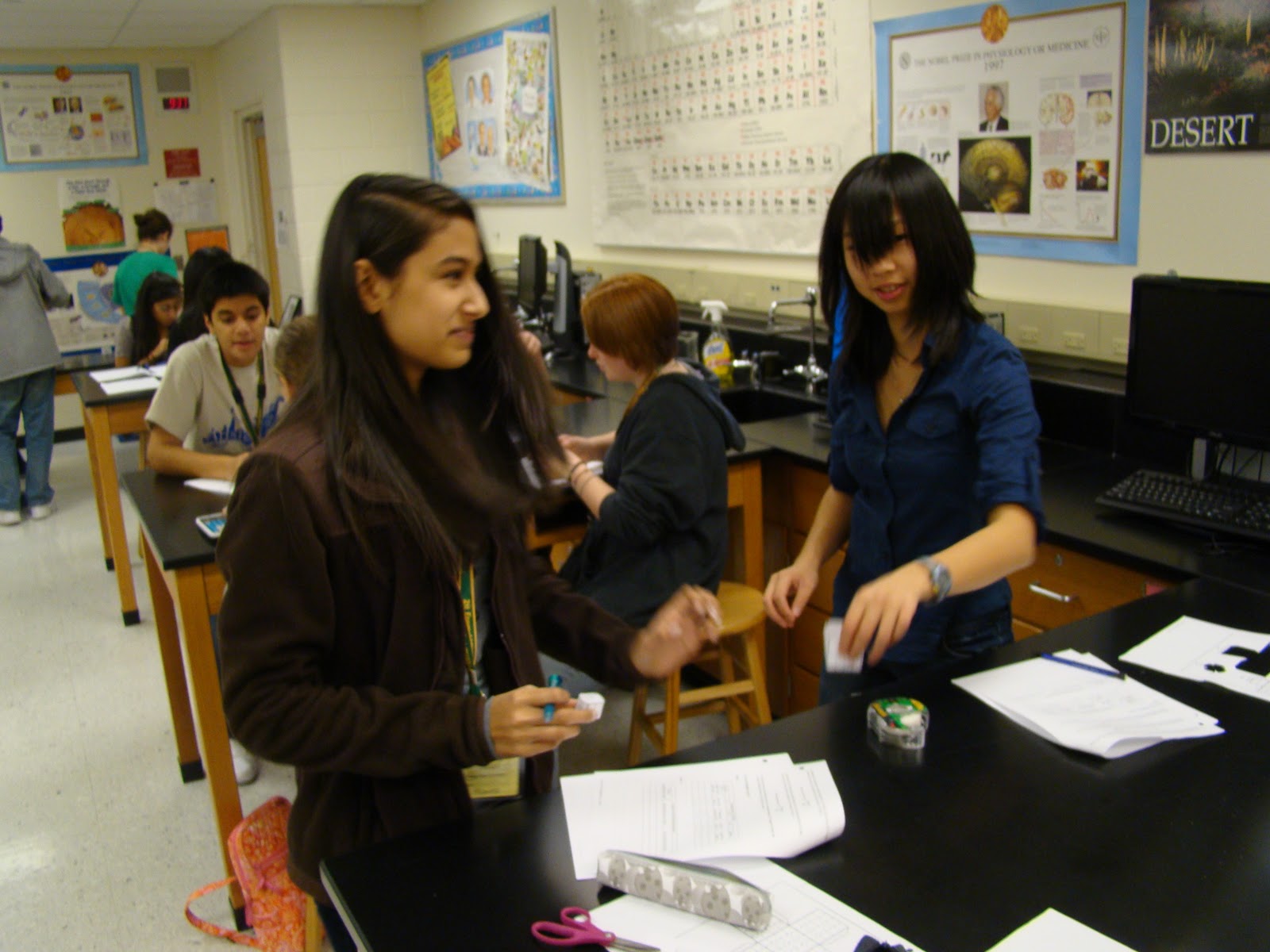
Have a good week!
March 12, 2011
March 13, 2011
March 13, 2011
Happy Early St. Patrick's Day everyone!
Events of the Past Week
Monday - On Monday we had our second genetics quiz. Most students did very well on the quiz - I was really impressed with their efforts!
Tuesday - On Tuesday we spent the day counting our fruit flies. Since the last day of counting had been Friday, there were LOTS of flies to count! There was no homework assigned on Tuesday.
Wednesday - The students were introduced to the concept of genes being carried on the same chromosome. This changes the expected ratios in the offspring compared to all of our previous problems, and is probably the most difficult concept of our genetics unit for most students. I also introduced the students to Google Documents, which allows everyone in their group access to the same document. They can be working on it at the same time, and observing their group members edit it in real time. In addition, they can chat while they edit so that any changes that are made can be discussed. It is a really powerful tool that you should have them show you if you are not familiar with it. Finally, Problem Set 5 was assigned for homework.
Thursday - We learned about a statistical tool called chi-squared analysis. This tool allows students to compare actual, observed results from a genetic cross with those that were expected. After completing this analysis of actual data, they should be able to determine whether their data falls within an acceptable range of the expected results, or if they have collected really bad data!
Friday - The students were introduced to a concept known as nondisjunction, which can lead to the inheritance of one too many or one too few chromosomes. This leads to inherited genetic disorders such as Down's Syndrome, Edward's Syndrome, Patau Syndrome, and others.
Upcoming Events
Monday - Every group will be given the opportunity to work on their fruit fly reports in class. The test was initially scheduled to be given Tuesday and Wednesday, but since Tuesday is a late start day, there would not be enough time for students to complete their tests. Therefore, the test was pushed back one day, and the day for working on the fruit fly reports was bumped up.
Tuesday - This will be a review day for the genetics test the students will be taking on Wednesday and Thursday. The students will get several practice problems and the answer key to the problems to use to help study. I will be at an AP conference this day. The test covers two days because genetics problems take a long time to work out as compared to our normal multiple choice questions on other tests. There are not too many more questions than what we normally have on a test.
Wednesday - Students will take Day 1 of their genetics test.
Thursday - Students will take Day 2 of their genetics test.
Friday - The fruit fly reports are due. They will NOT be accepted late, so even if nobody from the group is in class, I expect the reports to be e-mailed to me by the time class starts. Everyone has been made aware of this expectation. After the test, we will be watching a video called "Ghost In Your Genes" about the impact the environment can have on your genes. It is a really well-done NOVA video.
Graba Geek of the Week
Pat Pazerunas is the geek of the week this week! He has done very well on his genetics problems and with his flies. Most importantly, Pat very bravely and generously shared with us about his relative with Down's Syndrome when we were discussing the inheritance of Down's as well as the effects of Down's Syndrome on individuals who inherit it. He also made us aware that March 21st is World Down's Syndrome Day. This date is chosen because individuals with Down's Syndrome have 3 copies of the 21st chromosome (3-21). To find out more about this day, you can visit http://www.worlddownsyndromeday.org/.

Have a good week and an enjoyable spring break! The next post will be March 27th.
Happy Early St. Patrick's Day everyone!
Events of the Past Week
Monday - On Monday we had our second genetics quiz. Most students did very well on the quiz - I was really impressed with their efforts!
Tuesday - On Tuesday we spent the day counting our fruit flies. Since the last day of counting had been Friday, there were LOTS of flies to count! There was no homework assigned on Tuesday.
Wednesday - The students were introduced to the concept of genes being carried on the same chromosome. This changes the expected ratios in the offspring compared to all of our previous problems, and is probably the most difficult concept of our genetics unit for most students. I also introduced the students to Google Documents, which allows everyone in their group access to the same document. They can be working on it at the same time, and observing their group members edit it in real time. In addition, they can chat while they edit so that any changes that are made can be discussed. It is a really powerful tool that you should have them show you if you are not familiar with it. Finally, Problem Set 5 was assigned for homework.
Thursday - We learned about a statistical tool called chi-squared analysis. This tool allows students to compare actual, observed results from a genetic cross with those that were expected. After completing this analysis of actual data, they should be able to determine whether their data falls within an acceptable range of the expected results, or if they have collected really bad data!
Friday - The students were introduced to a concept known as nondisjunction, which can lead to the inheritance of one too many or one too few chromosomes. This leads to inherited genetic disorders such as Down's Syndrome, Edward's Syndrome, Patau Syndrome, and others.
Upcoming Events
Monday - Every group will be given the opportunity to work on their fruit fly reports in class. The test was initially scheduled to be given Tuesday and Wednesday, but since Tuesday is a late start day, there would not be enough time for students to complete their tests. Therefore, the test was pushed back one day, and the day for working on the fruit fly reports was bumped up.
Tuesday - This will be a review day for the genetics test the students will be taking on Wednesday and Thursday. The students will get several practice problems and the answer key to the problems to use to help study. I will be at an AP conference this day. The test covers two days because genetics problems take a long time to work out as compared to our normal multiple choice questions on other tests. There are not too many more questions than what we normally have on a test.
Wednesday - Students will take Day 1 of their genetics test.
Thursday - Students will take Day 2 of their genetics test.
Friday - The fruit fly reports are due. They will NOT be accepted late, so even if nobody from the group is in class, I expect the reports to be e-mailed to me by the time class starts. Everyone has been made aware of this expectation. After the test, we will be watching a video called "Ghost In Your Genes" about the impact the environment can have on your genes. It is a really well-done NOVA video.
Graba Geek of the Week
Pat Pazerunas is the geek of the week this week! He has done very well on his genetics problems and with his flies. Most importantly, Pat very bravely and generously shared with us about his relative with Down's Syndrome when we were discussing the inheritance of Down's as well as the effects of Down's Syndrome on individuals who inherit it. He also made us aware that March 21st is World Down's Syndrome Day. This date is chosen because individuals with Down's Syndrome have 3 copies of the 21st chromosome (3-21). To find out more about this day, you can visit http://www.worlddownsyndromeday.org/.
Have a good week and an enjoyable spring break! The next post will be March 27th.
March 6, 2011
March 6, 2011
March 6, 2011
Thank you to many of you for the kind birthday wishes!
Monday - Students were introduced to the inheritance of blood types after getting back their quizzes from Friday. It seemed as though most students picked this up pretty quickly! Afterwards, everyone had time to count the flies from the second generation of offspring in their vials and work on some problems. Homework was problems 1-7 on Problem Set 4.
Tuesday - I was home sick myself, so the students had classroom time to work on practice genetics problems. There was a great report from the substitute teacher. My classes are great this year - obviously the parents of my students are doing something right at home! I have not had a single complaint from a sub this year.
Wednesday - On Wednesday the students were introduced to something called the Hardy-Weinberg Theorem by having them taste some PTC paper. Ask your kids if they can explain the theorem to you, and if they can describe the taste of the PTC paper! Afterwards there was time to count flies and work on problems. Homework was problems 8-10 on Problem Set 4.
Thursday - My son woke me up at 5am with a fever and terrible cough/nasal congestion so I was home again. The students worked on some practice Hardy-Weinberg problems, as well as practice problems reviewing our other genetics topics. The sub's report again was great!
Friday - We checked the students' problems from Thursday, then had time to count flies and prepare for Monday's quiz. The fruit fly project report was explained to the students as well. The report must be typed, and is due at the beginning of the period on March 18th. One report will be turned in per lab team. It will NOT be accepted late for any reason, since two weeks notice was given and it is to be typed. Even if nobody from the group is in class, then somebody can e-mail it to me as an attachment by the time class begins on the 18th.
Upcoming Events
Monday - There is a quiz scheduled for Monday. It was originally scheduled for last week, but due to my absences and having to count flies, it was pushed back until Monday. After the quiz there will be time to count flies.
Tuesday - This will be a day for counting flies and working on the students' fruit fly reports.
Wednesday - This will be the students' last day to count flies from the second generation. We will learn about how two genes can be located on the same chromosome, and what impact that has on the ratios of different offspring expected to be produced by a cross. Afterwards there will be time to count flies. Problem Set 5 will be assigned for homework.
Thursday - Students will be introduced to a statistical tool called Chi-Square Analysis. This will be used by the students to analyze their data and see if it should be accepted or rejected. There will be practice problems assigned for homework. We will be doing a Chi-Square lab activity where we compare the expected numbers of M&M's of different colors in a bag of M&M's (using information provided by the Mars Candy Company) with the actual numbers of each color in a bag.
Friday - I will be lecturing on the inheritance of several different genetic diseases. We will be reviewing for our genetics test (which will be Tuesday the 15th and Wednesday the 16th).
Graba Geek of the Week
This week's Graba Geek of the Week is Amy Andersen. Amy not only earned a perfect score her genetics quiz last week, but she has also become a leader in identifying flies for her group - quite impressive!

February 27, 2011
February 27, 2011
Hello everyone! I turn 35 years old today - I've entered a new age demographic and I can be president. I don't really think I'm too interested in either one to be honest!
Events of the Past Week
Tuesday - Students were introduced to traits carried on the X chromosome called sex-linked (or X-linked) traits. They are expected to know that red-green colorblindness, hemophilia, and Duchenne muscular dystrophy are all carried on the X chromosome, and that males are much more likely to get these traits than females. Not only that, but males with X-linked traits must have inherited them from their mother because their father gives them a Y chromosome, so does not give them any genes at all for X-linked traits!
After the introduction to these traits, all the groups finished their last day of counting flies from the first generation of offspring. Problems 1-8 were assigned as homework from Problem Set 3.
Wednesday - I introduced pedigrees to the students today. Everyone seemed to do a good job of grasping the concept of looking at pedigrees to determine how a trait is inherited, and figuring out what genes each individual in the pedigree must have for one trait. We also looked at how hemophilia was passed from Queen Victoria (who was a carrier for the disease) on to her offspring, then to the royal houses of Spain, Prussia, and Russia. The spread to the Russian Royal family eventually led to the Russian Revolution and the rise of communism. As I told your children, it's all about biology! For homework, numbers 9 and 10 were assigned in Problem Set 3
Thursday - We listened to the song "I'm My Own Grandpa" by Ray Stevens, and the students attempted to draw a pedigree of the family described in the song. It was not easy! Afterwards we removed all of the parents from the vials for our second generation of flies, as their offspring will be emerging from their pupae soon! Then we looked at the answer key for Problem Set 3 so the students could grade their own papers and ask questions about what they got wrong. Finally, the worksheet "Human Pedigree Genetics" was assigned for homework.
Friday - We took our first genetics quiz on Friday. It consisted of 15 multiple choice questions and 1 short answer problem. All of the concepts we had covered to that point were included on the quiz. Afterwards, students read the article "Go Ahead, Kiss Your Cousin (Heck marry her if you want to)" from Scientific American.
Upcoming Events
Monday - We will be checking to see if we need to count flies from the second generation yet. If so, we will probably spend most of the period counting, as this generation will take a little bit longer to count than the previous generation. If not, then I will introduce the students to the inheritance of blood types, which exhibit both multiple alleles and codominance. I won't explain that here, but it might be a good idea to ask your children to try to explain it to you. You might also ask them to explain the difference between codominance and incomplete dominance. If they can't, please encourage them to ask those questions in class or come see me for some extra help. I will also introduce the Hardy-Weinberg Theorem to the students. Problem Set 4 will be assigned for homework on Monday if I introduce those topics rather than have the students count flies. If we count flies, then there will be no homework on Monday.
Tuesday (Late Start Day) - We will either be counting flies or doing some practice Hardy-Weinberg problems Tuesday. My best guess is that this is the first day we will be counting flies for the second generation, however.
Wednesday - The students will be introduced to the concept of having two genes linked together on the same chromosome, which will change the expected ratios of offspring with different traits. We will also have some time to count flies. Problem Set 5 will be assigned for homework.
Thursday - Genetics Quiz #2 will be given on Thursday if everything goes according to plan on the first 3 days of the week. If fly counting pushes us back, then the quiz will be either Friday or Monday. We may need to count flies on Thursday.
Friday - If the students have already taken the quiz, then they will be introduced to nondisjunction, which is an error that occurs during meiosis leading to an extra chromosome being inherited by the offspring. This can lead to many disorders, such as Down's Syndrome, Patau Syndrome, and Edward's Syndrome, to name a few. There will also be time to count flies.
Graba Geek of the Week
The first ever Graba Geek of the Week goes to Zach Hebebrand, who knew without being told that Charles Darwin's birthday was on February 12th, the same day as Abraham Lincoln's. Very impressive! Zach has also been doing very well with our genetics problems so far.
Have a great week everyone.
Events of the Past Week
Tuesday - Students were introduced to traits carried on the X chromosome called sex-linked (or X-linked) traits. They are expected to know that red-green colorblindness, hemophilia, and Duchenne muscular dystrophy are all carried on the X chromosome, and that males are much more likely to get these traits than females. Not only that, but males with X-linked traits must have inherited them from their mother because their father gives them a Y chromosome, so does not give them any genes at all for X-linked traits!
After the introduction to these traits, all the groups finished their last day of counting flies from the first generation of offspring. Problems 1-8 were assigned as homework from Problem Set 3.
Wednesday - I introduced pedigrees to the students today. Everyone seemed to do a good job of grasping the concept of looking at pedigrees to determine how a trait is inherited, and figuring out what genes each individual in the pedigree must have for one trait. We also looked at how hemophilia was passed from Queen Victoria (who was a carrier for the disease) on to her offspring, then to the royal houses of Spain, Prussia, and Russia. The spread to the Russian Royal family eventually led to the Russian Revolution and the rise of communism. As I told your children, it's all about biology! For homework, numbers 9 and 10 were assigned in Problem Set 3
Thursday - We listened to the song "I'm My Own Grandpa" by Ray Stevens, and the students attempted to draw a pedigree of the family described in the song. It was not easy! Afterwards we removed all of the parents from the vials for our second generation of flies, as their offspring will be emerging from their pupae soon! Then we looked at the answer key for Problem Set 3 so the students could grade their own papers and ask questions about what they got wrong. Finally, the worksheet "Human Pedigree Genetics" was assigned for homework.
Friday - We took our first genetics quiz on Friday. It consisted of 15 multiple choice questions and 1 short answer problem. All of the concepts we had covered to that point were included on the quiz. Afterwards, students read the article "Go Ahead, Kiss Your Cousin (Heck marry her if you want to)" from Scientific American.
Upcoming Events
Monday - We will be checking to see if we need to count flies from the second generation yet. If so, we will probably spend most of the period counting, as this generation will take a little bit longer to count than the previous generation. If not, then I will introduce the students to the inheritance of blood types, which exhibit both multiple alleles and codominance. I won't explain that here, but it might be a good idea to ask your children to try to explain it to you. You might also ask them to explain the difference between codominance and incomplete dominance. If they can't, please encourage them to ask those questions in class or come see me for some extra help. I will also introduce the Hardy-Weinberg Theorem to the students. Problem Set 4 will be assigned for homework on Monday if I introduce those topics rather than have the students count flies. If we count flies, then there will be no homework on Monday.
Tuesday (Late Start Day) - We will either be counting flies or doing some practice Hardy-Weinberg problems Tuesday. My best guess is that this is the first day we will be counting flies for the second generation, however.
Wednesday - The students will be introduced to the concept of having two genes linked together on the same chromosome, which will change the expected ratios of offspring with different traits. We will also have some time to count flies. Problem Set 5 will be assigned for homework.
Thursday - Genetics Quiz #2 will be given on Thursday if everything goes according to plan on the first 3 days of the week. If fly counting pushes us back, then the quiz will be either Friday or Monday. We may need to count flies on Thursday.
Friday - If the students have already taken the quiz, then they will be introduced to nondisjunction, which is an error that occurs during meiosis leading to an extra chromosome being inherited by the offspring. This can lead to many disorders, such as Down's Syndrome, Patau Syndrome, and Edward's Syndrome, to name a few. There will also be time to count flies.
Graba Geek of the Week
The first ever Graba Geek of the Week goes to Zach Hebebrand, who knew without being told that Charles Darwin's birthday was on February 12th, the same day as Abraham Lincoln's. Very impressive! Zach has also been doing very well with our genetics problems so far.
Have a great week everyone.
February 21, 2011
February 21, 2011
Happy President's Day everyone! Do you know which famous biologist shares a birthday with Abraham Lincoln? If not, ask your kids, they should know since we talked about it the week before last!
Events of the Past Week
Monday - On Monday we spent time counting our flies, as there were a lot to count after 2 days of no counting! I helped students with their classification on Monday and Tuesday so they would get the hang of identifying males and females. By the end of the week they were real pros!
Tuesday (Late Start Day) - The students were introduced to many of our vocabulary terms as well as how to predict the results of a monohybrid (one trait) cross using a Punnett Square. We used the ability to roll your tongue as the trait to introduce the topic. Problem Set 1 was assigned for homework.
Wednesday - On Wednesday students counted their flies after taking a genetics vocabulary quiz. Most students did very well on this.
Thursday - Thursday the students learned how to predict the results of a dihybrid (two trait) cross using a Punnett Square. We looked at polydactyly (having extra fingers like former Chicago Cubs pitcher Antonio Alfonseca) and brachydactyly (having shortened digits, like Megan Fox does on one of her thumbs) as the two traits in our introductory problems. After the introduction, students were given time to count flies. Numbers 1-6 of Problem Set 2 were assigned for homework.
Friday (Half Day) - Anyone who earned a C or lower on our meiosis quiz had to retake a new version of the quiz, and those who earned a B or higher had the option to retake the quiz. Students also counted their flies this day. Numbers 7-9 of Problem Set 2 were assigned for homework. The problem set will be collected on Tuesday.
Upcoming Events
Monday - NO SCHOOL! Happy Presidents' Day!
Tuesday - Sex-linked traits (traits carried on the X chromosome) will be introduced. These traits include hemophilia, red-green colorblindness, and Duchenne Muscular Dystrophy. Quick quiz - do you know anyone who is colorblind? What is their gender? If you're looking for something quick to do with the family, do a survey with your family about anyone you know who has red-green colorblindness and see what they all seem to have in common. Your children should be able to explain why the people with red-green colorblindness all have this one thing in common after Monday. When I'm done introducing this topic, students will be given time to work on counting their flies. This will be the last day for counting flies from the first generation of offspring. Problem Set 3, numbers one through eight will be assigned for homework.
Wednesday - Students will be introduced to pedigrees (family trees), including Queen Victoria's pedigree. We'll trace hemophilia through her family and learn how the fact that she was a carrier for hemophilia contributed to the Russian Revolution and the rise of communism! Problem Set 3, numbers nine and ten, as well as a sex-linked traits worksheet will be assigned for homework.
Thursday - Students will be given a quiz on monohybrid crosses, simple dominance, dihybrid crosses, incomplete dominance, testcrosses, and sex-linked traits. Afterwards, they will work on an assignment titled "Human Pedigree Genetics" in which they will try to identify the genotypes (the pair of genes a person carries for one trait) and phenotypes (physical appearance) of many individuals in 3 different pedigrees. We will also listen to the song "I'm My Own Grandpa" by Ray Stevens and attempt to draw a pedigree of the family described in the song.
Friday - Students will be introduced to the inheritance of traits which have multiple alleles (which means there are many different versions of the gene in the human population. One example is blood types, which have an A gene, a B gene, and an O gene). This is opposed to other traits we've studied so far, such as tongue rolling, which only have two versions of the gene in the human population (the version that allows you to roll your tongue, and the version that doesn't allow you to roll your tongue). We will also learn about the Hardy-Weinberg theorem, which explains the conditions necessary for a population's genetic makeup to NOT change over time. Since these conditions never all exist, this theorem helps show that a population's genetic makeup is always changing over time. Afterwards, Problem Set 4 will be assigned.
Have a good week everyone!
Events of the Past Week
Monday - On Monday we spent time counting our flies, as there were a lot to count after 2 days of no counting! I helped students with their classification on Monday and Tuesday so they would get the hang of identifying males and females. By the end of the week they were real pros!
Tuesday (Late Start Day) - The students were introduced to many of our vocabulary terms as well as how to predict the results of a monohybrid (one trait) cross using a Punnett Square. We used the ability to roll your tongue as the trait to introduce the topic. Problem Set 1 was assigned for homework.
Wednesday - On Wednesday students counted their flies after taking a genetics vocabulary quiz. Most students did very well on this.
Thursday - Thursday the students learned how to predict the results of a dihybrid (two trait) cross using a Punnett Square. We looked at polydactyly (having extra fingers like former Chicago Cubs pitcher Antonio Alfonseca) and brachydactyly (having shortened digits, like Megan Fox does on one of her thumbs) as the two traits in our introductory problems. After the introduction, students were given time to count flies. Numbers 1-6 of Problem Set 2 were assigned for homework.
Friday (Half Day) - Anyone who earned a C or lower on our meiosis quiz had to retake a new version of the quiz, and those who earned a B or higher had the option to retake the quiz. Students also counted their flies this day. Numbers 7-9 of Problem Set 2 were assigned for homework. The problem set will be collected on Tuesday.
Upcoming Events
Monday - NO SCHOOL! Happy Presidents' Day!
Tuesday - Sex-linked traits (traits carried on the X chromosome) will be introduced. These traits include hemophilia, red-green colorblindness, and Duchenne Muscular Dystrophy. Quick quiz - do you know anyone who is colorblind? What is their gender? If you're looking for something quick to do with the family, do a survey with your family about anyone you know who has red-green colorblindness and see what they all seem to have in common. Your children should be able to explain why the people with red-green colorblindness all have this one thing in common after Monday. When I'm done introducing this topic, students will be given time to work on counting their flies. This will be the last day for counting flies from the first generation of offspring. Problem Set 3, numbers one through eight will be assigned for homework.
Wednesday - Students will be introduced to pedigrees (family trees), including Queen Victoria's pedigree. We'll trace hemophilia through her family and learn how the fact that she was a carrier for hemophilia contributed to the Russian Revolution and the rise of communism! Problem Set 3, numbers nine and ten, as well as a sex-linked traits worksheet will be assigned for homework.
Thursday - Students will be given a quiz on monohybrid crosses, simple dominance, dihybrid crosses, incomplete dominance, testcrosses, and sex-linked traits. Afterwards, they will work on an assignment titled "Human Pedigree Genetics" in which they will try to identify the genotypes (the pair of genes a person carries for one trait) and phenotypes (physical appearance) of many individuals in 3 different pedigrees. We will also listen to the song "I'm My Own Grandpa" by Ray Stevens and attempt to draw a pedigree of the family described in the song.
Friday - Students will be introduced to the inheritance of traits which have multiple alleles (which means there are many different versions of the gene in the human population. One example is blood types, which have an A gene, a B gene, and an O gene). This is opposed to other traits we've studied so far, such as tongue rolling, which only have two versions of the gene in the human population (the version that allows you to roll your tongue, and the version that doesn't allow you to roll your tongue). We will also learn about the Hardy-Weinberg theorem, which explains the conditions necessary for a population's genetic makeup to NOT change over time. Since these conditions never all exist, this theorem helps show that a population's genetic makeup is always changing over time. Afterwards, Problem Set 4 will be assigned.
Have a good week everyone!
February 13, 2011
February 13, 2011
Happy Valentine's Day!
Events of the Past Week
Monday - On Monday we began our pop bead chromosome activity so that the students could get a hands-on experience to learn the process of meiosis. The activity was not completed in one class period, so we had to continue working on it on Tuesday.
Tuesday - On Tuesday, we completed the meiosis pop bead chromosome activity. When everyone completed the activity there was not enough time to start a new activity, so we watched a quick video clip on tissue engineering from NOVA. Here is a link to the video: Replacing Body Parts.
Wednesday - I didn't feel that we were ready to take a quiz today, so we did a few other things to reinforce our learning about the process of meiosis instead. The quiz was pushed to Friday because we had to remove the parents from our fruit fly vials on Thursday. The students learned about the formation of sperm cells and egg cells through a 15 minute lecture that I gave to them. Then we did a kinesthetic learning activity where the students used playing cards to act out the process of meiosis. When they finished this activity, we discussed as a class the ways in which meiosis increases the genetic diversity of a species, and why it is important that a species is genetically diverse.
Thursday - We began our Drosophila melanogaster (fruit fly) project. Students learned how to knock their flies out, how to determine the gender of a fruit fly (seriously!), and the stages of the life cycle of the fruit fly. After this, they actually did knock out their flies and identify the mutations that their flies showed. They were required to tell me once they thought that they had identified the mutations, and I let them know whether they were correct or not. On Monday, every class but 8th hour will begin counting and classifying the offspring of the flies they worked with this day. 8th hour already began that process on Friday after their quiz. I believe these flies went through their life cycle a little bit faster because the classroom we are in during 8th hour (Room 251) is a little bit warmer than my other classroom (room 245).
Friday - We took our quiz on meiosis. When the students finished, they worked on their genetics vocabulary worksheets, which are due on Monday. There will be a quiz on the terms on that sheet next week Wednesday.
Upcoming Events
Monday - On Monday we will be working with our Drosophila melanogaster. I will also be checking to see that everyone has completed their genetics vocabulary worksheet.
Tuesday - Students will be introduced to Punnett Squares, monohybrid crosses, testcrosses, and incomplete dominance. Afterwards, they will be given problem set 1, which will be due on Wednesday. If there is enough time, they will be able to work with their flies.
Wednesday - We will be working with our flies, I believe (it depends on what it looks like in their vials), and then students will be introduced to dihybrid crosses and given Problem Set 2, which will be due on Thursday.
Thursday - The groups will be given some time to count their flies again, and then will be introduced to sex-linked inheritance of genes (that is, genes that are carried on the X chromosome, such as hemophilia, red-green colorblindness, and Duchenne muscular dystrophy). Up to question 7 on Problem Set 3 will be assigned.
Friday - On Friday we will first be taking a retake of the meiosis quiz. This is a new quiz over the same topics as the first one. Anyone who earned a C or lower must retake the quiz, and I will then average the scores of the two quizzes together to determine a grade in the gradebook. Anyone who earned an A or a B has the option of doing the retake, but if they do I will still average the two scores together, no matter what they get on the second quiz.
After that, we will be taking a look at Queen Victoria's family tree, tracing the inheritance of hemophilia through the royal families of Europe. This will be the inroduction students receive to pedigrees. Afterwards, they will be assigned the rest of Problem Set 3, and given time to work with their flies.
Other tidbits
During our genetics unit, all plans are tentative. I have to be flexible with the students and allow them enough class time to work with their flies, so we may or may not complete everything I have planned for them for the week (and that's OK). The hands-on experience they are getting right now is an experience that they will not forget, and I believe it will also help them improve their knowledge of genetics.
Have a good week everyone!
Events of the Past Week
Monday - On Monday we began our pop bead chromosome activity so that the students could get a hands-on experience to learn the process of meiosis. The activity was not completed in one class period, so we had to continue working on it on Tuesday.
Tuesday - On Tuesday, we completed the meiosis pop bead chromosome activity. When everyone completed the activity there was not enough time to start a new activity, so we watched a quick video clip on tissue engineering from NOVA. Here is a link to the video: Replacing Body Parts.
Wednesday - I didn't feel that we were ready to take a quiz today, so we did a few other things to reinforce our learning about the process of meiosis instead. The quiz was pushed to Friday because we had to remove the parents from our fruit fly vials on Thursday. The students learned about the formation of sperm cells and egg cells through a 15 minute lecture that I gave to them. Then we did a kinesthetic learning activity where the students used playing cards to act out the process of meiosis. When they finished this activity, we discussed as a class the ways in which meiosis increases the genetic diversity of a species, and why it is important that a species is genetically diverse.
Thursday - We began our Drosophila melanogaster (fruit fly) project. Students learned how to knock their flies out, how to determine the gender of a fruit fly (seriously!), and the stages of the life cycle of the fruit fly. After this, they actually did knock out their flies and identify the mutations that their flies showed. They were required to tell me once they thought that they had identified the mutations, and I let them know whether they were correct or not. On Monday, every class but 8th hour will begin counting and classifying the offspring of the flies they worked with this day. 8th hour already began that process on Friday after their quiz. I believe these flies went through their life cycle a little bit faster because the classroom we are in during 8th hour (Room 251) is a little bit warmer than my other classroom (room 245).
Friday - We took our quiz on meiosis. When the students finished, they worked on their genetics vocabulary worksheets, which are due on Monday. There will be a quiz on the terms on that sheet next week Wednesday.
Upcoming Events
Monday - On Monday we will be working with our Drosophila melanogaster. I will also be checking to see that everyone has completed their genetics vocabulary worksheet.
Tuesday - Students will be introduced to Punnett Squares, monohybrid crosses, testcrosses, and incomplete dominance. Afterwards, they will be given problem set 1, which will be due on Wednesday. If there is enough time, they will be able to work with their flies.
Wednesday - We will be working with our flies, I believe (it depends on what it looks like in their vials), and then students will be introduced to dihybrid crosses and given Problem Set 2, which will be due on Thursday.
Thursday - The groups will be given some time to count their flies again, and then will be introduced to sex-linked inheritance of genes (that is, genes that are carried on the X chromosome, such as hemophilia, red-green colorblindness, and Duchenne muscular dystrophy). Up to question 7 on Problem Set 3 will be assigned.
Friday - On Friday we will first be taking a retake of the meiosis quiz. This is a new quiz over the same topics as the first one. Anyone who earned a C or lower must retake the quiz, and I will then average the scores of the two quizzes together to determine a grade in the gradebook. Anyone who earned an A or a B has the option of doing the retake, but if they do I will still average the two scores together, no matter what they get on the second quiz.
After that, we will be taking a look at Queen Victoria's family tree, tracing the inheritance of hemophilia through the royal families of Europe. This will be the inroduction students receive to pedigrees. Afterwards, they will be assigned the rest of Problem Set 3, and given time to work with their flies.
Other tidbits
During our genetics unit, all plans are tentative. I have to be flexible with the students and allow them enough class time to work with their flies, so we may or may not complete everything I have planned for them for the week (and that's OK). The hands-on experience they are getting right now is an experience that they will not forget, and I believe it will also help them improve their knowledge of genetics.
Have a good week everyone!
February 6, 2011
February 6th, 2011
February 6th, 2011
"The best laid plans of mice and men . . ." is a quote that comes to mind after last week! The snow days caused a few changes to the plans we had. Hopefully everybody got through those days safe and sound (and not stuck on Lake Shore Drive)!
Events of the Past Week
Monday - The students watched the movie The Human Race about the Human Genome Project. It offered them some pretty interesting insight into the personalities of the biologists involved in that project, especially J. Craig Venter, Francis Collins, and James Watson. To see what Venter has been up to since the completion of the Human Genome Project, check out this article: http://www.wired.com/wiredscience/2010/05/scientists-create-first-self-replicating-synthetic-life/
Tuesday - On Tuesday we watched the movie "Harvest of Fear", a NOVA/Frontline special on genetically modified foods. Included was discussion of what they are, how they can be produced, and the potential benefits and harms of genetically modified foods.
Wednesday - My kids had fun - hope yours did too!

"The best laid plans of mice and men . . ." is a quote that comes to mind after last week! The snow days caused a few changes to the plans we had. Hopefully everybody got through those days safe and sound (and not stuck on Lake Shore Drive)!
Events of the Past Week
Monday - The students watched the movie The Human Race about the Human Genome Project. It offered them some pretty interesting insight into the personalities of the biologists involved in that project, especially J. Craig Venter, Francis Collins, and James Watson. To see what Venter has been up to since the completion of the Human Genome Project, check out this article: http://www.wired.com/wiredscience/2010/05/scientists-create-first-self-replicating-synthetic-life/
Tuesday - On Tuesday we watched the movie "Harvest of Fear", a NOVA/Frontline special on genetically modified foods. Included was discussion of what they are, how they can be produced, and the potential benefits and harms of genetically modified foods.
Wednesday - My kids had fun - hope yours did too!

Thursday - Yet another day off, but a little too cold to play outside!
Friday - Students took a quiz on biotechnology that had been scheduled for Wednesday. After turning in the quiz, they picked up a reading on meiosis, which they are supposed to either highlight or underline as they read it. The reading/highlighting is to be completed by Monday.
Upcoming Events
Monday - We will process the reading, focusing on the unique events of meiosis that create gametes (sperm and eggs) with half the chromosome number as the original, "mother" cell. We will also focus on the events of the first two stages of meiosis (prophase I and metaphase I) that create an incredible amount of genetic diversity in organisms that use meiosis to produce their gametes. After processing, we will begin our pop bead chromosome activity modeling the events of meiosis.
Tuesday - We will finish the pop bead chromosome activity, and then act out the events of meiosis as a class using playing cards as our chromosomes.
Wednesday - Students will take a quiz on meiosis. This plan is tentative and will depend on how far the class is able to get on their activities Monday and Tuesday. The quiz may have to be pushed back to Thursday depending on how things go on Monday and Tuesday. After the quiz, we will begin our classical (Mendelian) genetics unit by focusing on important vocabulary. Please make sure your children are spending time on this terminology! If they do not learn it early in our unit, they will be lost as we continue through it.
Thursday - The students will be introduced to Punnett Squares, monohybrid (one trait) crosses, incomplete dominance, and testcrosses. They will have the first of several problem sets to complete for homework.
Friday - We will spend time answering questions about the homework, which I will collect and grade five of the ten problems at random, with the goal of evaluating at least one problem on each of the different topics covered in the problem set. Then the students will be introduced to dihybrid (two trait) crosses. Homework will be Problem Set 2, due Monday.
I hope everyone enjoys (or enjoyed, depending on when you read this) the Super Bowl, or at least the Super Bowl commercials, and that we have a much less snowy week!
Subscribe to:
Posts (Atom)